When Minimalism Stops Working
There is a difference between a frame that has been stripped down to its essentials and a frame that simply has nothing in it.
A community member said something recently that we have not been able to stop thinking about. Sometimes minimalism is so quiet it does not say anything and loses its soul.
They are right. And it is worth unpacking why because minimalism is one of the most powerful tools available to black and white photographers and also one of the most easily misused.
The room analogy
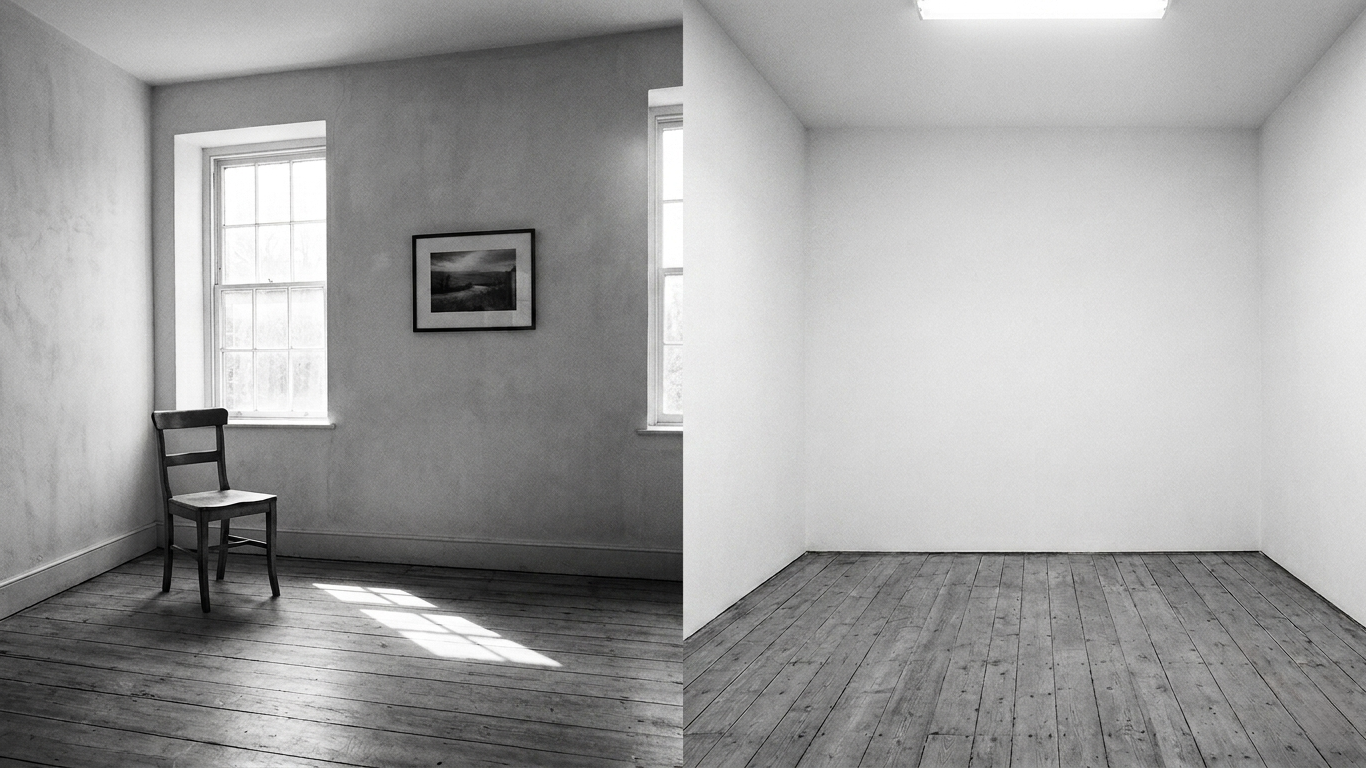
Think about two rooms that both have almost nothing in them.
The first room has been carefully considered. Every object in it is there for a reason. The single chair faces the window at exactly the angle that catches the afternoon light. The one framed photograph on the wall is the right photograph in the right place. The empty space around each object is not emptiness. It is the room breathing. You walk into it and feel something. There is a presence in it that has nothing to do with how much stuff is in it and everything to do with the intention behind each decision.
The second room is empty because nobody got around to furnishing it yet. Same white walls. Same bare floor. Same absence of clutter. But it feels completely different. There is no presence. There is just space waiting to be filled.
Both rooms have almost nothing in them. One of them says something. The other one is just empty.
Minimalist photography works exactly the same way.
Minimalism as a tool
When minimalism is working as a tool it is in service of something specific. You are removing what is competing with the subject. Stripping away what the eye does not need. Creating silence around the thing that matters so the viewer has nowhere to look except directly at it.
The removal is purposeful. Every decision about what stays and what goes is made in service of a specific feeling or idea or story. The empty space in the frame is not empty because you ran out of things to include. It is empty because the emptiness itself is saying something. It is the room that breathes.
Fan Ho understood this completely. His images are deeply minimal and absolutely full of feeling. The figures in his frames are often tiny against vast areas of light and shadow. The emptiness around them is charged with meaning. It speaks about solitude and scale and the particular quality of life in a city that moves around you while you stand still. The minimalism is not the point. It is the tool that makes the point possible.
Minimalism as a style
The other version of minimalism is when it becomes the goal rather than the means. The photographer is drawn to the clean empty frame, the single subject against a white sky, the long shadow on a bare wall, because those images look a certain way. Elegant. Considered. Serious. The quietness becomes a habit rather than a decision.
This is the unfurnished room. The walls are white. The floor is bare. Everything unnecessary has been removed. But there was nothing to remove it for. The simplicity is the whole point and the image has nothing to say beyond look how simple and clean this is.
These images are often technically accomplished. The composition is considered. The tonal relationships are handled well. But they leave you with nothing to hold onto. You look at them and then you move on because there was nothing asking you to stay.
The quietness the community member identified is exactly this. Not the charged silence of an image that has stripped everything away in service of something specific. The actual silence of an image that stripped everything away and then had nothing left.
How to tell the difference
The honest test is not whether the image looks minimal. It is whether the silence in the frame is doing any work.
Ask yourself what the empty space is saying. Not what it looks like. What it is saying. Is the emptiness around your subject making the subject feel more isolated. More exposed. More significant. Is the bare sky above your figure pressing down on them or lifting them. Is the shadow on the empty wall creating tension or mystery or a quality of stillness that means something.
If you can answer those questions the minimalism is working as a tool. If the honest answer is that the empty space is just empty space you are in the unfurnished room.
Ask yourself whether you chose this composition because it served what you wanted to say or because it looked like the kind of photograph you want to make. This is a harder question and it requires genuine honesty. There is nothing wrong with having a visual sensibility that tends toward the minimal. But the images that come from that sensibility only work when the minimalism is answering a specific need rather than expressing a general preference.
The practical thing worth trying
Before you press the shutter on a minimal composition ask one question. What is the silence for.
Not what does this look like. Not is this clean enough. What is the silence for. What is the emptiness doing. What is the space around the subject saying that the subject alone cannot say.
If you have a clear answer to that question press the shutter. The minimalism is working.
If the honest answer is that the silence is just how you like your photographs to look, go back and look longer. Find the thing the silence needs to be in service of. Find the feeling or the tension or the story that the emptiness can amplify. Find what the room needs to breathe around.
The difference between minimalism that stops you and minimalism that passes through you is almost always that simple. One of them knew what the silence was for. The other one was just quiet.