Learning to See: Part 1
A story about learning to see in black and white.
We have gotten some messages from people who are just starting out in black and white photography. They have been looking at work on the Collective for a while and something in it has gotten under their skin. They want to start but they are not sure how. They go out with a camera and come home disappointed. They cannot figure out why their images do not look anything like the ones that made them want to pick up a camera in the first place.
We have wanted to do something for those photographers for a long time. Not a technical guide. Not a list of tips. Something that actually reflects what it feels like to be at the beginning.
Over the coming weeks we are going to follow Alex through the early stages of that journey. The first outing. The moment light starts to make sense. The first image that surprises you. The bad patch that makes you want to quit. And eventually the first photograph that feels genuinely yours.
Alex is not real but the experiences are. Every photographer in the Collective has lived some version of this story. If you are just starting out we hope you recognize yourself in it. If you have been shooting for years we hope it takes you back to where you began.
This is part one. This is the first outing.
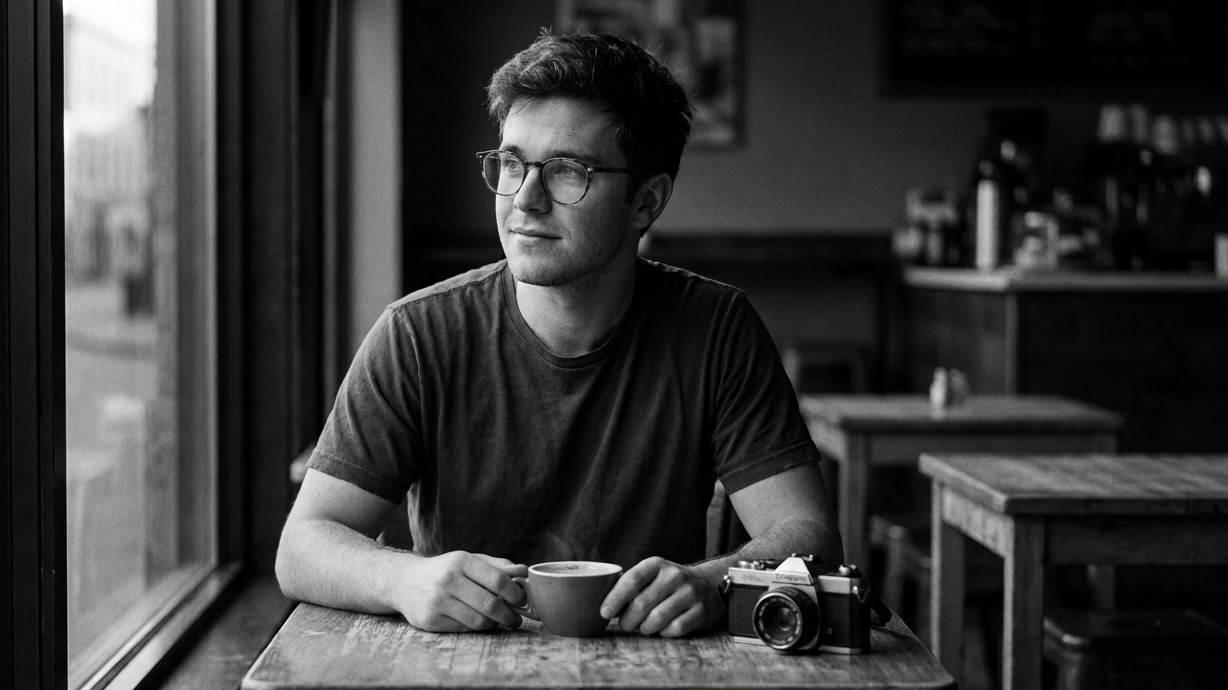
Alex had been looking at black and white photographs for months. Not casually. The way you look at something when it gets into you and will not leave. Scrolling through the Collective late at night, saving images without quite knowing why, trying to figure out what made one photograph stop you and another one pass through without leaving a mark.
Eventually there was only one thing to do about it.
One Saturday morning Alex charged the battery, put the camera in a bag, and went out.
The walk to the first location felt good. The camera was in the bag and the morning light was doing something interesting and there was that feeling of possibility you get before you have made any photographs yet and everything is still open. Alex had read something the night before about composition and golden hour light and something called the decisive moment, had looked at photographs by photographers whose work seemed effortless, and felt ready.
The first frame he made was about ten minutes in. A fire escape catching the morning light. Then a person walking past a blank wall. Then a puddle with a reflection in it. Then a doorway. Then a street corner. Then whatever seemed interesting, the shutter clicking again and again with the growing sense that something in here was going to be exactly right.
Two hours later Alex walked home with just over a hundred frames.
The images went onto the computer after dinner. Alex made a cup of tea and sat down to look at them.
The first image came up on the screen, and it was not what Alex remembered seeing. The fire escape that had looked so graphic and interesting in the morning looked ordinary and cluttered on the screen. The person walking past the wall was slightly blurry and positioned in a way that felt accidental. The puddle reflection was there, but so was half a parked car that Alex had not noticed. The doorway was just a doorway.
Frame after frame, each one a version of the same gap between what had seemed right in the moment and what the camera had actually recorded. By the time Alex reached the end of the folder, the tea was cold.
Here is the thing nobody tells you before the first outing. The camera does not see what you see. It never will.
Your eye has context. Memory. Feeling. The ability to focus on exactly what matters while quietly filtering out everything else. Alex looked at that fire escape and saw the graphic lines of it catching the light, and his brain filled in a sense of the image without registering the telephone wire crossing behind it, or the air conditioning unit above it, or the recycling bins at the bottom of the frame. The camera recorded all of it, with complete indifference, everything in the frame equally, without judgment about what mattered and what did not.
That gap between what the eye sees and what the camera captures is the central challenge of photography. Closing the gap is the whole journey. The first outing is just the first lesson in how large the gap actually is.
There was something else happening on that first outing too, something Alex could not have known to look for yet. Every frame was made because something seemed interesting. The fire escape. The person. The puddle. The doorway. Alex was photographing subjects.
But the camera does not care about subjects. It cares about light. The same fire escape in flat midday light and in the raking light of early morning are two completely different photographs. One of them is interesting. One of them is a record of a fire escape. The light on Saturday morning was beautiful, but Alex had been pointing the camera at the thing the light was falling on rather than at what the light was actually doing. That is a distinction that takes time to understand and even longer to see automatically.
Alex sat with the cold tea and the folder of disappointing frames and felt something close to deflation.
But here is what the deflation was actually saying. The eye was already ahead of the camera skills. Alex could see the gap between what had been made and what had been hoped for, and that gap is not a problem. It is exactly where you need to be. It is the space where everything that matters happens. It is the reason to go out again.
Before going out again though, Alex did three things.
The first was going back through all hundred frames and finding the single one that came closest to what had been intended. Not the best technically. The one that had the most of what Alex was actually trying to capture. It turned out to be a simple frame, a woman sitting on some steps with strong light falling across her from the left and a dark shadow behind her. Nothing fancy, but something in the tonal contrast and the stillness of her felt closer to the work that had been pulling at Alex for months than anything else in the folder. Alex looked at it for a long time trying to understand what it had that the others did not.
The answer was simple when it finally came. The light was doing something specific, and Alex had been close enough and still enough to let the camera record it. Everything else in the folder had been made too quickly and from too far away, and the light had not been the point.
The second thing Alex did was open the work of one photographer, a street photographer whose images had been saved over and over, and instead of just looking at the photographs the way you look at something beautiful, Alex started asking specific questions of each one. Where was the light coming from. Where did the photographer have to be standing to make this. What is not in this frame that could have been. What did they leave out and why. What were they waiting for. Half an hour of that kind of looking felt like more of an education than the entire two hour outing had produced.
The third thing Alex did was go into the camera settings and switch the display to show a black and white image on the screen while shooting. Not to convert color images afterward. To see in black and white in real time, to force the eye to stop thinking about color and start thinking about light and shadow and tone and form while actually standing in front of a scene.
The next Saturday morning came around. Alex picked up the camera, checked the display, saw the world rendered in black and white on the screen, and went out.
Something was already different.
We will pick up the story there next week.