What You're Actually Supposed to Learn From the Masters
One approach teaches you to see. The other teaches you to imitate. They look similar from the outside, but they lead to completely different places.
Every serious photographer is told the same thing at some point. Study the masters. Look closely at Cartier-Bresson, Fan Ho, Weston, Moriyama. Learn from the people who already figured out how to see.
That advice is correct. But there's a right way to study a master and a wrong way, and the two can look nearly identical from the outside while leading to completely different places.
The wrong way: studying the recipe
Think about the difference between memorizing a chef's exact recipe and actually learning to cook. If you memorize the recipe, you can reproduce that one dish precisely, the right ratio of salt, the exact cooking time, the specific ingredients listed in order. What you can't do is cook anything else. You've copied an outcome without understanding why it works.
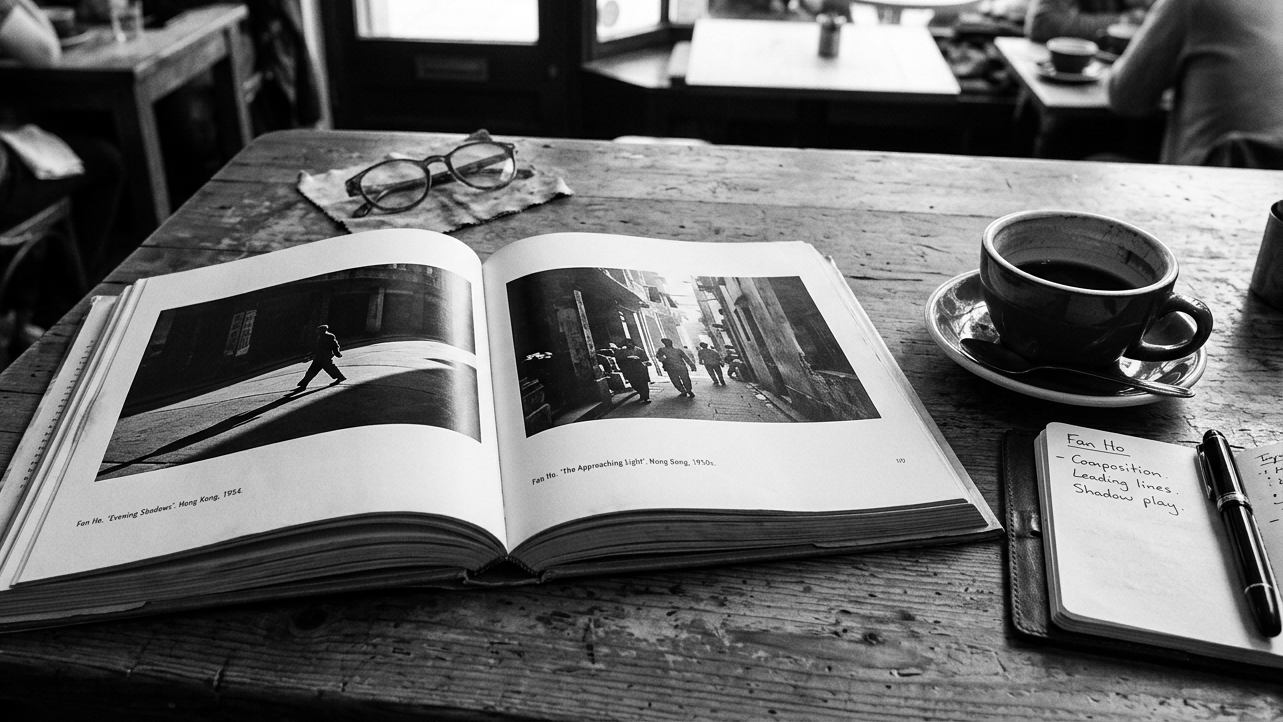
This is what most people default to when they study a master photographer, often without realizing it. You look at a Fan Ho photograph and you catalog its ingredients: high contrast, deep shadow on one side of the frame, a small isolated figure in a large geometric space, shot on the streets of 1950s Hong Kong. Then you go looking for a wall with strong directional light, wait for someone small to walk into the empty space, and push the contrast hard in post to match. You've reproduced the dish. You still don't know how to cook.
The tell that you're studying the recipe rather than the cooking: you can describe exactly what a master's photographs look like, but you can't say why they were looking at what they were looking at, or what they were actually trying to find.
The right way: studying why they cook the way they cook
A chef who's actually taught you something hasn't just handed you a recipe. They've shown you why they reach for certain flavors, what they're trying to make someone feel when they eat the dish, how they think about balance and timing. Once you understand that, you don't need their recipe anymore. You can cook with whatever's in your own kitchen, for the people actually sitting at your own table, and it'll still carry something of what they taught you, without being a copy of anything they made.
This is the more useful way to study a photographer. Not what does this look like, but what was this person actually curious about. What did they keep returning to, over and over, across their entire body of work, not just the one famous frame everyone reproduces. Fan Ho wasn't chasing "high contrast shadow shots." He was fascinated by how the geometry and light of ordinary Hong Kong streets could turn daily life into something almost theatrical, and by the particular solitude of a single person moving through a densely packed city. That's not a technique. It's an obsession. And the obsession is what produced the technique, not the other way around.
The tell that you're studying this way: you finish looking at someone's work and instead of wanting to reproduce their images, you find yourself asking sharper questions about your own life. What am I actually curious about. What have I been walking past because it didn't look like "a photograph" yet, even though something in me kept noticing it anyway.
A practical way to do this
Here's a question worth asking instead of "how do I make an image that looks like this." Ask instead: what would this photographer have found interesting about my own street, my own city, my own life, if they'd grown up here instead of where they did.
That question does something useful. It forces you to borrow the depth and seriousness of their attention while pointing it somewhere entirely your own. You're not trying to recreate their kitchen. You're learning how they thought about flavor, and then going to cook with what you actually have.
What this actually asks of you
Studying technique long enough to internalize it as a tool is worth doing. Learn how light works. Learn what tonal contrast does. Learn how a master builds a composition. That's the cooking lesson, and it matters.
But at some point, the study has to turn back toward your own life. Stop looking only at their photographs and start looking, with that same seriousness and patience, at what's actually in front of you. That's the only place a body of work that's genuinely yours can come from. Nobody else has your kitchen, your ingredients, or your table.