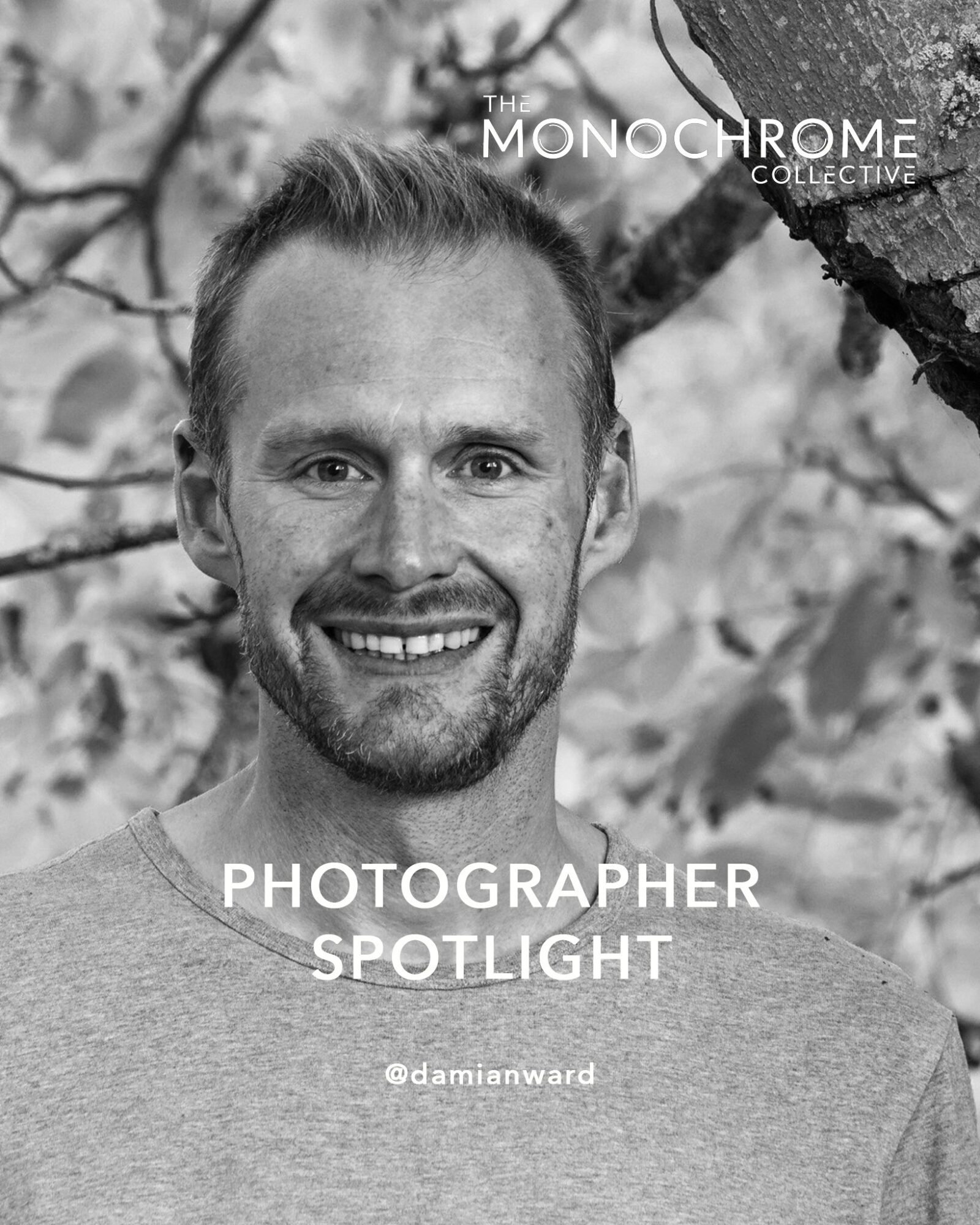
He spent years chasing perfection. Now the pylon in the background does not bother him at all.
Damian Ward found his real turning point the day he first owned a camera with interchangeable lenses, not because the gear itself mattered so much, but because it made him want to go out regularly rather than only occasionally. He thinks of himself as an outdoors person first, and that pull toward solitude shows up directly in his subject matter, woodland, solitary trees, and old architecture near where he lives, a landscape he describes as beautiful without being dramatic in the way popular photography locations tend to be.
People rarely appear in his frames, a deliberate choice meant to leave room for the viewer to place themselves inside the solitude rather than watch someone else experience it. He shoots almost entirely on vintage manual focus lenses, sets his camera to black and white before he ever presses the shutter, and edits so minimally that he barely touches his RAW files anymore, trusting the JPEG to already reflect exactly what he intended. We asked him about the early years spent chasing perfection, and why he has come to believe imperfect images carry more feeling than pristine ones ever could.
Here is our interview:
There’s always a moment that pulls someone into photography for good. What was yours?
Taking ownership of my first camera with interchangeable lenses was probably my turning point. I previously only used compact cameras, which work well for my needs, until I wanted to use them for something beyond their capabilities. Using this camera made me want to go out regularly to make images, rather than just making the occasional image. It also made me want to learn how to use a camera properly.
What subjects are the focus of your work and why?
I think of myself as an outdoors person; I feel happiest when I am outside. Because of this, the landscape was an obvious focus. The area where I live, although beautiful, is not dramatic like the popular locations for landscape photography. It does, however, have a lot of wonderful, clean woodland and solitary trees. These trees and woodland became the main focus for my photography, especially in the wintertime when they have dropped their leaves to reveal their bare branches. I also enjoy old architecture and traces of human presence within the landscape. People rarely feature in my images, as I prefer to convey the feeling of solitude that the viewer can place themselves into.
Your black and white work has a particular feeling to it. How did you arrive at that? Was it deliberate or did it emerge over time?
I like to think we all inject something personal and unique into the images we make. Style and vision are something we develop over time, but deep down we all know what we want to achieve, even if we are not able to do it at an early stage. When I first started photography, black and white images were something I wanted to make. But as I wanted to make landscape-focused images, I thought that they needed to be in colour. A big turning point for me was just doing what I want, rather than doing what I think others want to see.
Tell us the story behind one of your favorite photographs.
Gosh, how do you pick a favourite image, and if I did pick one, it probably would not have an interesting story behind it. The majority of my images are made in a state of flow, so I am not that conscious of anything, including my surroundings sometimes.
I go out most days to make images. The places I visit are not that remarkable, and I often visit them on the way to work or bolt them on with me going somewhere, or perhaps when I am out riding my bike. Because of this, I don’t really think they have much of a background story.
What is one thing that you are working to improve in your photography and how are you going about it?
As photographers, we are constantly learning and improving ourselves. Whether that be technical, or knowledge of locations, or subject matter, we keep on progressing. We should all experiment, try new ideas, and have failures. In my opinion, this is how we learn and improve.
The area I should try to improve is self-promotion. I loathe anything to do with Facebook or Meta, and I do not take part in competitions. So getting my work seen can be difficult. I have recently started exhibiting my images locally again and also submitting to some magazines. This should help a little.
How much do you plan vs. shoot spontaneously?
I tend to revisit locations that are close to me and that I know well. They require no planning, other than perhaps checking the weather forecast.
I regularly pin locations on Google Maps of places I want to visit or think will be of interest. This tends to be the only planning I do. I can then pull up the map and see if anything is interesting close by when I am in an area that I do not know so well.
I prefer to be responsive to the location and what is happening at the time. Rather than spending hours researching and it ending up not being entirely as I expected. I learnt early on that planning normally ends with disappointment.
What gear do you bring when you go out to shoot?
These days, I try to minimise the amount of kit I carry. I often go out with just a vintage manual-focus prime lens on my camera, of which I own quite a few. I also own a couple of modern zoom lenses that tend to come out in bad weather because of their weather sealing or when I think I want to work faster with autofocus.
I rarely use a tripod anymore, other than for long exposures or in woodland where the light level is too low to hand-hold. Filter-wise, I only really use neutral density filters. Either a 10-stop for long exposures or a 2-stop for when I want to use the lens wide open in bright light.
What does your editing process look like? What tools do you use and how do you approach it?
I try to keep my editing as simple as I can. The more I can get right in camera, the better it is for me. I do not have the time to spend hours editing images.
I have my camera set up in black and white, and I adjust the contrast and exposure to suit how I feel the image should look. The vintage lenses I use also have a certain look to them. The camera will save the file as JPEG and RAW, but I rarely use the RAW files anymore as the JPEGs reflect how I set up the camera.
After moving away from Adobe a couple of years ago, I now use Affinity Photo for my post-processing. My workflow is pretty basic. I bring up the exposure, as I like to underexpose everything to protect the highlights. I will then make some basic tonal adjustments either with curves or dodging and burning certain areas. Apart from a bit of cloning out dust spots and making sure things are straight, that is about it.
Who are some photographers or artists that have influenced your style and why?
There are too many to mention them all, but here are the most influential.
Bill Brandt, for his deep, dark shadows.
Albert Renger-Patzsch for his realism.
Josef Sudek for his sombre romanticism.
Harry Callahan for his minimalism.
Fay Godwin for her love of the landscape.
Bernd and Hilla Becher for showing us that ordinary and ugly can be beautiful.
Karl Blossfeldt for making me look closer at botanicals.
Michael Kenna, for his travel and showing me the places I now want to visit.
Eugène Atget for making images of everything that was on his doorstep.
Frederick H. Evans for old architecture.
Edwin Smith again for old architecture.
Edward Weston for making at least 30 images of green peppers.
I am currently inspired and retracing the footsteps of Victor Albert Prout. Like him, I am making panoramic images of the Thames between London and Oxford.
What would you tell yourself when you started in photography? The thing nobody said to you that would have changed how you photographed?
Not to worry about perfection so much and embrace imperfection.
I spent a long time early on trying to make everything as perfect as I could. Whether it was not taking an image because there is a pylon in the background or worrying about sharpness or critical focus.
I now think imperfect images have more feeling. Images that look too pristine or are heavily edited just leave me cold.
If you would like to see more of Damians work you can find him on foto @damianward