Every Landscape Has Characters. Are You Finding Them?
Stop describing what a place looks like. Start telling us what is happening there.
Most landscape photographs are beautiful descriptions. They show you what a place looks like at a particular moment. The mountain. The valley. The waterfall catching the light. They are often technically accomplished and visually striking. But they do not make you feel anything beyond a general appreciation for the scene.
The reason is simple. Description is not story. And photography, like every other form of creative expression, is most powerful when it tells a story rather than just reports what was there.
The good news is that every landscape already contains everything a story needs. You just have to learn to see it differently.
Your landscape already has characters
The first shift is learning to look at landscape elements not as compositional objects but as characters. This is not a metaphor to be applied loosely. It is a genuinely different way of seeing that changes what you look for and what you wait for before you press the shutter.
A mountain is not just a shape on the horizon. It is a presence. Ancient, immovable, indifferent to everything happening around it. A waterfall is not just a visual element with a pleasing tonal quality. It is restless, persistent, always in motion, cutting through whatever stands in its way. A forest is not just a textured mass in the lower third of the frame. It is a crowd, dense and anonymous, keeping its own counsel.
When you start seeing your landscape elements this way the question changes from what should I include in this frame to who is in this scene and what are they doing to each other.
Light defines character
Here is where it gets interesting. The same characters in the same landscape look completely different depending on what the light is doing. And that difference is not just aesthetic. It is narrative. Light reveals character the way a good author reveals a character through action and consequence rather than description.
Look at these two photographs of the same view from Tunnel View in Yosemite. El Capitan in the foreground. Half Dome in the distance. Bridalveil Fall on the right. The same characters in both frames. Same location. Same composition. But they are telling completely different stories.
In the first image the light is doing something extraordinary. The sun is low and partially obscured, sending a shaft of light deep into the valley between the rock faces. El Capitan on the left is almost entirely in shadow, a massive dark presence pressing in from the edge of the frame. Half Dome catches just enough light in the distance to feel like it is calling you toward it. And Bridalveil Fall on the right is lit from behind, glowing against the dark cliff face, fragile and luminous against all that stone.
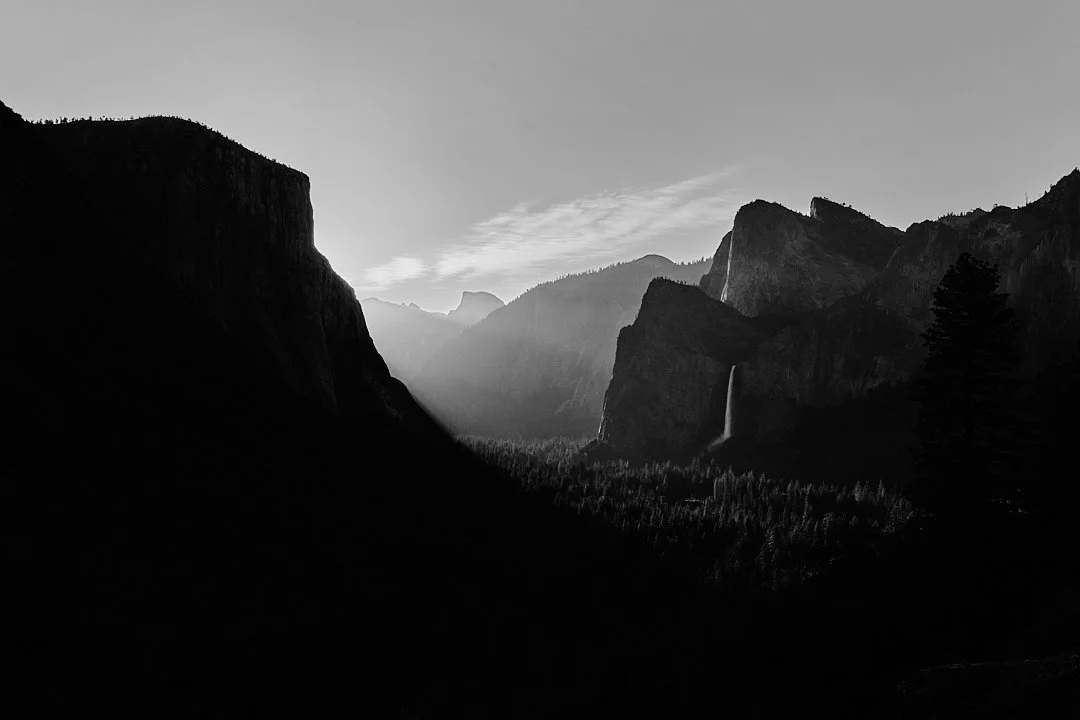
El Capitan is brooding. Half Dome is beckoning. Bridalveil Fall is defiant. These are characters with distinct personalities revealed by the light. The image has tension because these personalities are in conflict. The darkness pressing in from the left against the light reaching in from the right. The massive and ancient against the delicate and persistent. Something is at stake in this frame.
In the second image the same characters are present but the light is flat and even. El Capitan is fully visible and fully readable. Half Dome sits comfortably in the distance. Bridalveil Fall is there if you look for it. Everything is present and nothing is happening. The characters have no personality because the light has not given them any. There is no tension. No conflict. No story. Just a description of a famous view.
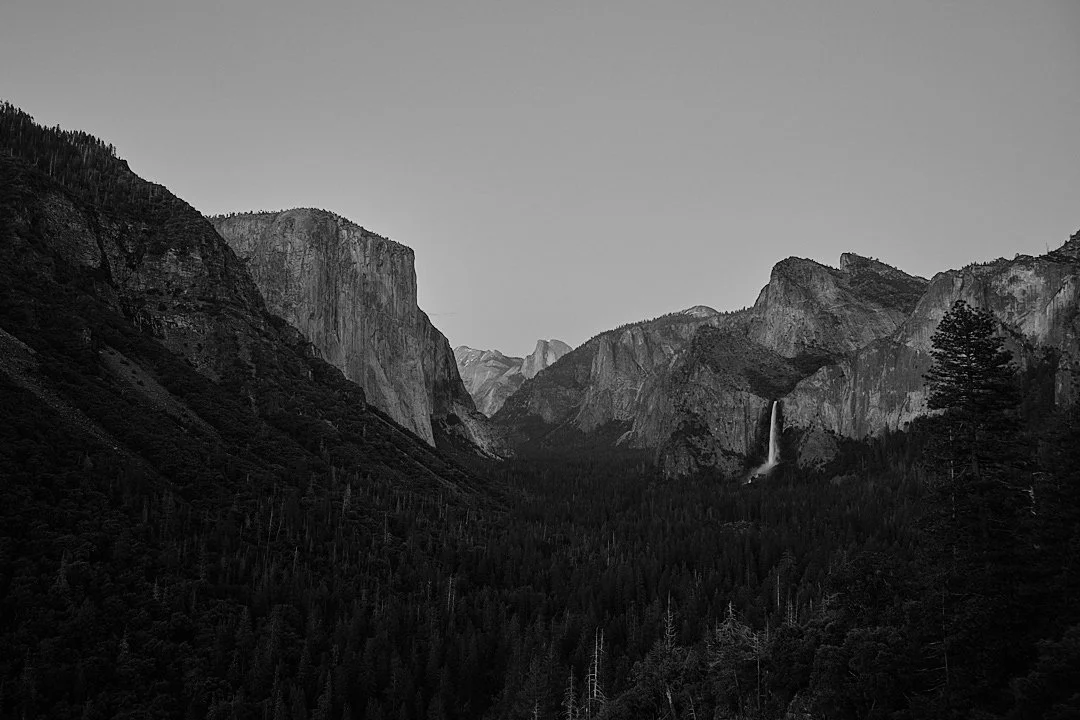
Both photographs are technically competent. Only one of them makes you feel something.
Conflict is what makes you feel something
Every story worth reading has conflict. Not necessarily dramatic conflict. Just tension between opposing forces. In a landscape that conflict might be the delicate against the massive. The temporary against the permanent. Light against darkness. Motion against stillness. The small human trace in an indifferent natural world.
Conflict is what raises a question in the viewer's mind. The question does not need to be answered. Often it is better when it is not. What happens to that waterfall when the drought comes. Will the light reach the valley floor before the shadow takes it. The tension without resolution is sometimes the most powerful story of all because it keeps the viewer inside the image working on it.
In the first Yosemite image the conflict is the light itself. That shaft of warm light reaching into a scene dominated by dark stone. It will not last. The sun is still moving. The shadows are still advancing. You are seeing a moment of contest between light and darkness and the outcome is not yet decided. That is why the image compels. You want to know what happens next even though you know a photograph cannot tell you.
What to look for in the field
The practical shift is to stop asking what does this look like and start asking what is happening here. When you arrive at a location look for the characters first. What are the dominant elements and what qualities do they have. Ancient and immovable. Restless and persistent. Fragile and luminous. Crowded and anonymous.
Then watch the light. Not just for when it is technically optimal but for when it reveals the character of your subjects most specifically. The light that turns El Capitan from a geological fact into a brooding presence is not the same light that makes it look its sharpest or most detailed. The narrative light and the descriptive light are often different and they arrive at different times.
Look for the tension between your characters. What is the conflict in this scene. Where is the darkness pressing against the light. Where is the small thing standing against the vast thing. Where is the motion interrupting the stillness.
And then wait. Because the light that reveals all of this is usually brief. It arrives and goes faster than you want it to. The second Yosemite image could have been taken almost any time in the hour before or after. The first one existed for minutes. That is not an accident. The story was always there. The light just told it.