Do You Prefer Odd or Even Numbers?
It Says More About You Than You Think. Go back through your favorite images and count. You'll probably find a pattern you never knew you had.
Have you ever looked at a photograph of three people and felt drawn in, then looked at one of two people and felt like something was missing, without being able to say why? Or maybe it's the opposite for you. A pair feels calm and complete and a trio feels cluttered, like the eye doesn't know where to settle.
Most photographers have a quiet preference for odd numbers or even numbers running through their work and have never once noticed it. We want to help you find out which one you are, and what it actually says about you. We also want to show you how to stop letting it happen by accident and start using it on purpose.
Why odd numbers tend to hold the eye longer
There's a long standing idea in photography and design that odd numbers of subjects create more visual interest than even numbers. One, three, five. The reasoning usually given is that even numbers create symmetry the eye resolves instantly and then moves past, while odd numbers leave something unpaired, and that imbalance keeps the eye looking a little longer. Two people standing together reads as a pair. Three people reads as a group with a dynamic. Someone's in the middle. Someone's being looked at by two others. Someone's slightly apart.
That's true more often than not. With two subjects the eye creates a relationship between them and once it's found, there isn't much left to discover. With three subjects there are more possible relationships. The eye can move between all of them, can group two against one, can find a triangle of attention instead of a single line. There's just more for it to do.
What this is actually telling you about yourself
Here's the more honest version of this, and the one that actually matters for you. This isn't really a rule with a right answer. It's a preference. And the preference is revealing something about your own temperament that has nothing to do with technique.
Some photographers are instinctively drawn to odd numbers. Trios. A lone figure set against a group. A single tree on an otherwise empty horizon. They're responding to a pull toward asymmetry, tension, the unresolved. Their compositions often carry a sense of movement or unfinished energy even when nothing in the frame is actually moving. Something is still happening, or about to.
Other photographers are instinctively drawn to even numbers. Pairs. Mirrored elements. Two windows, two figures, two trees framing a path. They're responding to a pull toward order, calm, resolution. Symmetry creates a feeling that everything has found its place. There's nothing left hanging. These images often feel quieter, more deliberate, more contained.
Neither one is correct. That's the part most writing on this topic gets wrong, because it usually frames odd numbers as the technically superior choice and even numbers as something to be fixed. The more honest position is that a photographer who is calmed by symmetry and a photographer who is energized by asymmetry are both responding to something real and consistent in themselves, and it shows up in their work whether they mean it to or not.
Does this hold for objects too?
This holds for objects too, not just people, though the reasoning shifts slightly. Objects don't have gaze or gesture, so the eye is doing pure pattern recognition rather than reading a relationship. Two identical objects placed symmetrically resolve almost instantly and the eye has nowhere else to go. Three objects break that symmetry naturally, since there's no way to divide three evenly, so the eye works a little harder to parse the arrangement and stays with it longer. This is part of why classic still life painting and photography lean so heavily on groupings of three. It's one of the oldest compositional habits there is, and it's the same instinct at work, just without a face attached to it.
There's an exception worth knowing about too. Sometimes repetition itself is the point. A long row of identical telephone poles, or windows, or chairs, isn't trying to avoid symmetry. It's using rhythm as the entire subject. In those images you're not asking the eye to find one focal point, you're asking it to feel a pattern. That's a different kind of image with a different kind of appeal, and it's worth knowing the difference so you're not fighting your own instincts when repetition is actually what the photograph needs.
Using numbers on purpose instead of by accident
Once you know your own instinct you can start using numbers deliberately instead of just defaulting to them. Numbers aren't only about holding attention. They can carry meaning, and the best photographers use them the way a writer chooses a word.
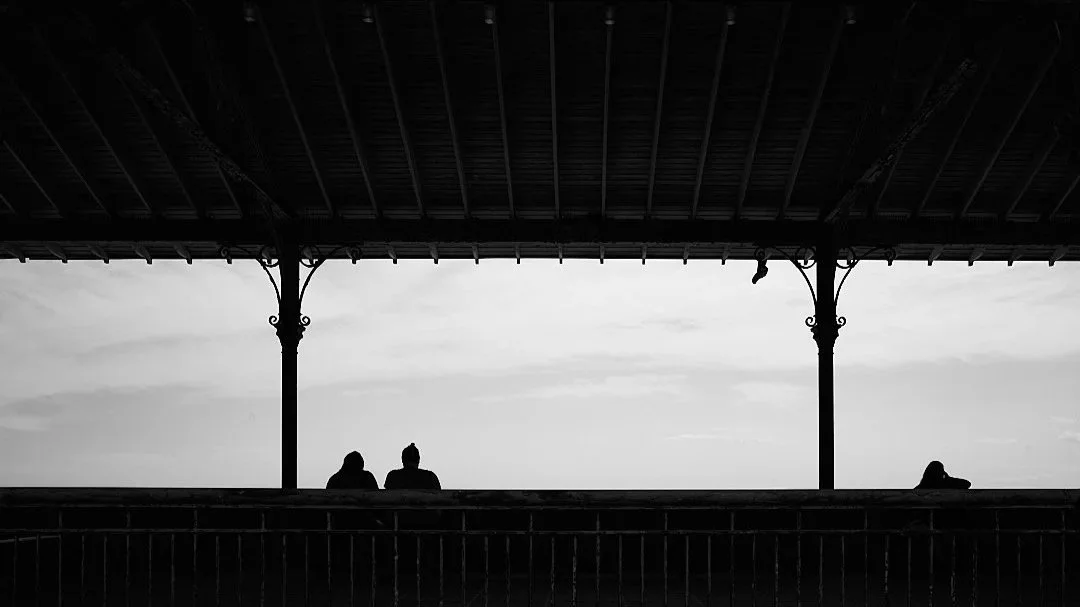
Two figures with space between them can say distance, even when the subject is a couple standing close in real life. Crop tighter and remove that space and the same two people can say intimacy instead. The number hasn't changed. The message has.
Three figures with one slightly turned away or set apart can say exclusion or tension, the third person not quite part of the group. Three figures evenly spaced and facing the same direction can say unity instead, a small crowd with one shared focus. Same count, opposite message, decided entirely by spacing and gesture.
A single subject alone in a vast frame says smallness, vulnerability, isolation. The same single subject filling most of the frame says presence, confidence, weight. One number, two completely different feelings, depending on how much room you give it.
Even numbers used deliberately can communicate balance, partnership, or completeness, a couple, a set of matching doors, two birds on a wire. Odd numbers used deliberately can communicate imbalance, a story still unfolding, or an outsider, three chairs at a table built for four.
This is the real use of the odd and even question. Not picking the technically superior option, but asking yourself what you want the number in your frame to say, and then choosing the count and the spacing that actually says it.
Try this
Go back through your own favorite images. Not your most technically accomplished ones, the ones you're genuinely proudest of, or the ones that get the strongest reaction from people who see them. Don't analyze them yet. Just count. How many dominant elements are in each one. See what shows up more often than you expected.
Then ask yourself something a little bigger. Does the number that keeps showing up match what calms you in life, or what excites you? Are you someone who feels settled by order and resolution, or someone who's drawn to a little unresolved tension?
And the next time you're out shooting, try the opposite of your instinct on purpose. If you always reach for three, frame a pair instead and see what it does to the feeling of the image. If you always reach for symmetry, let a third element wander into the frame and leave it slightly off balance. You might not like the result. But you'll learn something true about your own eye either way.