Photographer Spotlight: Lee Griffith
A photographer who finds the rotting log more interesting than the forest, and the three poppies more interesting than the meadow.
Lee Griffith's photography started in a 7th grade Industrial Arts class with a teacher whose name he can no longer remember, but whose darkroom changed everything. Two years later he spent every dollar from his part time jobs buying the school's secondhand darkroom equipment and set it up himself in a shed, light leaks sealed with duct tape, chemistry stored in bottles given to him by the local mortician. He has been making photographs ever since, though he resists calling it a focus.
He shoots intimate landscape details rather than grand vistas, the rotting log instead of the forest, three poppies instead of the meadow, and ninety-five percent of his work is spontaneous, shot within five kilometers of where he lives on whichever camera feels right that day, a Polaroid, a Hasselblad, occasionally a Contax TVS he's owned since his kids were small. A near-death experience at seventeen gave him an urgency to capture moments before they're gone, and a high-contrast printing style learned from a small rural high school yearbook printer has stayed with him for decades, mellowing only slightly with age. We asked him about light, presets, and why he's trying to think less and shoot more.
Here is our interview:
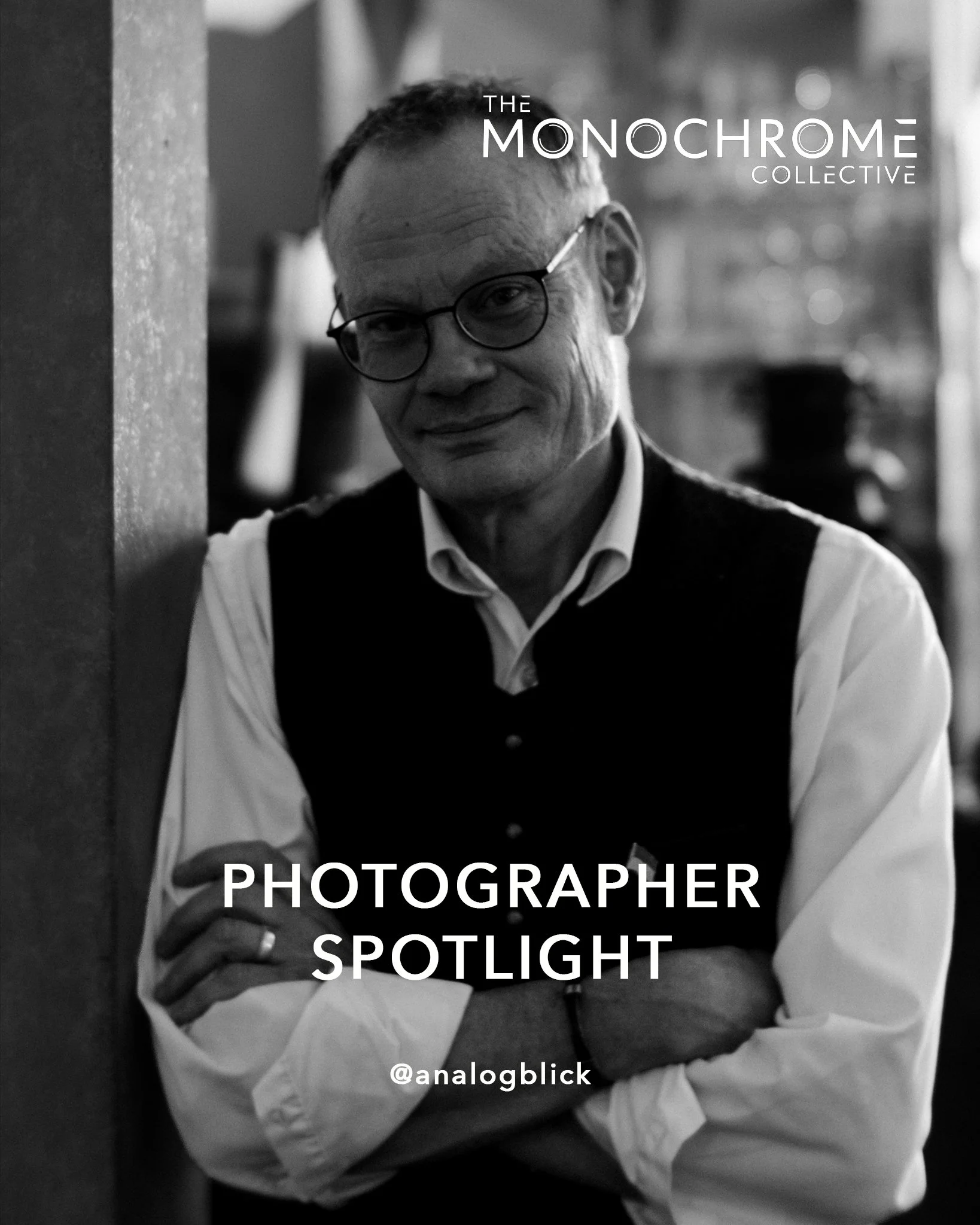
There's always a moment that pulls someone into photography for good. What was yours?
Industrial Arts 7th grade. I can't remember the name of our teacher but he introduced me to the wonder of developing my own film and printing my first black and white prints. I couldn't get enough of it after that. Two years later I used all the money I had saved from my part time jobs and bought the second hand equipment the school was selling as they modernized their darkroom. It ended up in a shed where light leaks were taped over with duct tape and the chemistry was stored in bottles I was given by the mortician.
What subjects are the focus of your work and why?
That's a difficult one - because I am all over the place. I have my stranger portraits project to push me into something I don't usually do - photograph people - to force me (once in blue moon) out of my comfort zone. I have no real subject focus - I look for things that catch my eye, usually involving light from an angle and a bit of shadow. Most of my work would be what I like to call up close up landscape photography - I like the more intimate details of a landscape and not just the vista. The rotting log, not just the forest, three poppies instead of the meadow, that type of thing.
Why is also difficult. When I was 17 I had a near death experience I don't share - but I will share the motivation it gave me. I realized at that moment that I could literally die any time. I don't get to choose - and with that realization came an overwhelming urge to capture moments, freeze time, not forget. Not even forget the moment I would dearly forget - because I remember the light. A green-golden glow, a softness to everything, and I have wanted to capture that light again - that epiphany, again. So my why is almost as curious as my what.
Your black and white work has a particular feeling to it. How did you arrive at that? Was it deliberate or did it emerge over time?
I like strong contrast. I think it comes from having developed the prints for the high school yearbooks for years. At that time the printers wanted photos with high contrast to print in those books - at least the printers a small rural high school in Western Canada gets. So I learned to expose my negatives to get that look, and how to print it, and it has stayed with me ever since. I try, now that I am aging and supposedly mellowing, to mellow that look, but hints of it always creep into my black and white work - unless of course its Polaroid - and then its the luck of the draw.
Tell us the story behind one of your favorite photographs.
It's a photograph, basically a snapshot, of my wife looking back at me over her shoulder. She is sitting on a concrete slab, wearing a leather jacket and a grey scarf with pink stripes. I think it was in a parking lot somewhere in France, and she smiles back at me as I trailed up to her. I just raised the camera, focused quickly - at that time I had an Olympus OM2 - and snapped the photo. We had been married a year, it was only my second time in Europe and I was overwhelmed by the cultures, the languages, the sights - and that this beautiful woman had chosen me to be her partner for the rest of her life. I have thousands of photos of my wife - but that one is still probably my most favorite.
What is one thing that you are working to improve in your photography and how are you going about it?
I am trying to experiment more. Let something that should be in focus be out of focus. Let the rules of composition fall by the wayside. I know that sounds counterintuitive but I feel it isn't. It lets me concentrate more on the moment and the emotion and feeling I hope to convey - you might have noticed I just don't photograph - I write. And I am honing my writing to be more direct and more emotionally balanced by letting myself be freer with construction and style. I believe - and I may be mistaken - that by doing the same with my photography I will produce better work. Not everyone will like it - but I will - and that's what counts for me now.
How much do you plan vs. shoot spontaneously?
I have projects I deliberately plan - photographing the funnel beaker culture graves in the area here for example, or a series I did years ago in the vineyards of the area where we used to live. But that would be at most 5% of the photographs I take. Unless I am walking with my wife - because she just gets too annoyed at me stopping after three meters for that flower, and that shadow - I always take a camera with me, choosing which to take by how I feel when I put my hand in the dry cabinet. So 95% is spontaneous.
What gear do you bring when you go out to shoot?
I could rattle off a long list here but I won't. I take the camera that feels right that morning or afternoon when I manage to get out and walk. 95% of my photos are taken in a 5km radius of the place I live. At the moment I gravitate to either a Polaroid (i2, SX70, 680) or one of Hasselblads (CFV50ii or X2D). A year ago it would have been my Leica M6 or the 500C Hasselblad for analog or my M10 for digital. The M6 and M10 have been traded because my eyesight and rangefinders just don't match anymore but I do miss them. That doesn't stop me from picking up the DP Merril an old friend sent me, or my Contax TVS or the Canon Photura I still own when that was the only camera I had to take photos of my kids with. It really is a "What camera feels right?" situation. And more often than not - I bring the wrong camera.
What does your editing process look like? What tools do you use and how do you approach it?
I try and do no post-processing at all. It's the old school in me - get it right in camera and then you have an easy time to print it. Of course I dodged and burned and masked and everything else you can do in a darkroom when I still hand printed everything - but that felt right. I have never got the same joy from a computer program, so I learn what I have to and leave it at that - and try and get everything to a look I like straight out of the camera. When I do post-process, except for my astrophotography stuff, it's very simple - maybe tweak the exposure or contrast a bit or use the clarity slider or clear view plus in DxO. For getting the black and white look I want from an original color photograph then I have spent some time creating presets in DxO that give me what I like and I just drop the photo in, choose it and apply the preset. Presto.
Who are some photographers or artists that have influenced your style and why?
Susan Sontag - her philosophy on photography has probably influenced me more than any living or dead photographer. Edward Weston's absolute perfect use of tonality - something I may strive for but haven't yet quite achieved. Sebastiao Salgado, both for his ecological vision and the starkness of his photographs. Pure black and white in my opinion. And then a photographer probably few have heard of - Michael Ruetz - his photobook "The Family of Dog" is absolutely wonderful. I find his approach to the subject, his compassion for dogs, and his photographic style - also heavier on the contrast in many of his photos - very compelling.
What would you tell yourself when you started in photography? The thing nobody said to you that would have changed how you photographed?
Don't think so much. Just do it.
If you would like to see more of Lee’s work you can find him on foto @analogblick