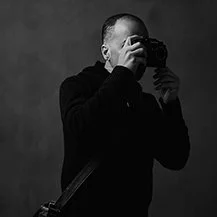
Photographer Spotlight: Onni Laine
on Street Photography, Restlessness, and the Voyage Into the Unknown
Onni Laine had been shooting photography intermittently for years before a 2024 trip to Japan gave him something he had not had before, a real direction. Street photography found him there, and he still looks back at the ten or fifteen decent frames from that trip with real affection, even though his style has changed considerably since.
What he is drawn to is not simply the people who inhabit a city but the atmosphere itself, an urban feeling he describes as oppressive, slightly paranoia inducing, and that is exactly what he is trying to put in the frame. He shoots almost entirely spontaneously, a Ricoh GRIII in hand most days, an Olympus XA loaded with Kentmere 400 when he wants film, and he is candid about where his work currently falls short. Too many silhouettes in doorways, too many clever reflections, not enough of the documentary storytelling he actually wants to be doing. He has projects in mind to fix that. We asked him about the cat tracks on a frozen lake, the photographers who shaped him, and the one piece of advice he wishes someone had given him earlier.
Here is our interview:
There's always a moment that pulls someone into photography for good. What was yours?:
A decisive moment came during my trip to Japan in 2024. I has been doing photography for a while intermittently, without a real direction, style or purpose. All of which I started to discover during my time there, when I first got into photographing streets. Although my style and way of shooting definitely have changed since, I still look at those 10 maybe 15 decent photos from that trip with special affection.
What subjects are the focus of your work and why?
Streets, not necessarily constrained to simply portraying people that inhabit them but the general atmosphere of urban life as I feel it. It has always felt somewhat oppressive to me, slightly paranoia-inducing. That is what I hope to capture.
Your black and white work has a particular feeling to it. How did you arrive at that? Was it deliberate or did it emerge over time?
Both deliberate and accidental. I have always experimented, and I've never taken classes or even done any technique or stylistic self study. I have studied the work of photographers I admire and taken notes from them. All of this has coalesced into how I currently do things, and I'm still mapping out my photographic instincts and I think I will be doing so as long as I live.
Tell us the story behind one of your favorite photographs.
One of my favorite photos are the tracks of a wild cat heading out on a frozen lake, shot on fomapan film, after a snowstorm has wiped it smooth. Although I had been following the cat tracks to maybe get a shot of it I realized the photo just works better if there is no cat in it. If it's just the tracks it leaves the resolution of the story open to the viewer. It's the start of a voyage into the unknown and that's the essence of what I wanted to portray.
What is one thing that you are working to improve in your photography and how are you going about it?
I am not satisfied with the subject matter of my photography. I feel that this affects a lot of street photographers. I have taken enough photos of silhouettes in doorways and "clever" shots of blurry figures in reflections or broken glass... I want my work to have a more documentary angle to it, to tell a wider story, which it is desperately lacking as of present. I do have some ideas for projects where I could exercise storytelling and document people's lives in photography, and I'm going to pursue them in the coming months.
How much do you plan vs. shoot spontaneously?
About 90% spontaneous, 10% planned. Most often I find the unexpected brings about the best result.
What gear do you bring when you go out to shoot?
These days, a Ricoh GRIII might as well be glued to my hand. If not that, then I have my Olympus XA with a roll of kentmere 400 inside. I bring my Fujifilm more rarely with me, only when I feel that the longer focal length is necessary, and of course a few spare batteries to keep my tools working.
And the most recent addition is my godox it-32 flash!
What does your editing process look like? What tools do you use and how do you approach it?
For digital photography, I edit more and more on Snapseed on my phone, after using the camera app to wirelessly transfer the photos to it. For more complex sets I use capture one on my desktop or laptop.
I usually try to find the essence of what I was trying to capture and amplify that, usually through cropping, boosting contrast and pulling shadows to emphasize the meaningful part of the image.
Oh, and also grain, grain galore! For no smart reason, just because I like it.
Who are some photographers or artists that have influenced your style and why?
Daido Moriyama, for his subject matter, execution and incredible mood.Trent Parke, for his project "Camera is God", in my opinion the greatest street photography project ever. Sebastiao Salgado, for his incredible documentary work. Josef koudelka, for the same reason, and his commitment to his projects.
Honorable mention to Mike Brodie, whose project on trainhoppers is the blueprint of the kind of documentary lifestyle work I'd love to do in the future
What would you tell yourself when you started in photography? The thing nobody said to you that would have changed how you photographed?
Start asking strangers if they'd like to pose for you. They usually don't mind at all it turns out, when you have a professional looking camera in hand they are even flattered and it often leads to interesting conversations!
If you would like to see more of Onni’s work you can find him on foto @onni.laine