Photographer Spotlight: Andrew Griffiths
Minimal subject, maximum impact. That has always been the ideal.
Andrew Griffiths cannot point to a single moment that pulled him into photography, because there was never a before. He was carrying a bakelite Brownie camera through the Pennine hills of northern England at four or five years old, long before his mother thought to actually put film in it. That early instinct toward landscape has never really left him. He now works almost entirely within the river catchment near his home, from the headwaters of the Pennine moors down through towns and villages to the crowded center of Manchester, drawn specifically to the collision between wild land and human modification that Britain's small, crowded geography makes almost unavoidable.
A former newspaper photographer who admits he was always better in the darkroom than on assignment, he thinks of himself less as a single image photographer and more as a storyteller working in sequence, chasing what he calls minimal subject, maximum impact. He shoots with a single fixed lens Leica Q, edits entirely in Darktable using digital techniques that mirror his old darkroom process almost exactly, and never plans a shoot in advance. We asked him about Fay Godwin, the difference between commercial work and his own, and why he still has not arrived anywhere.
Here is our interview:
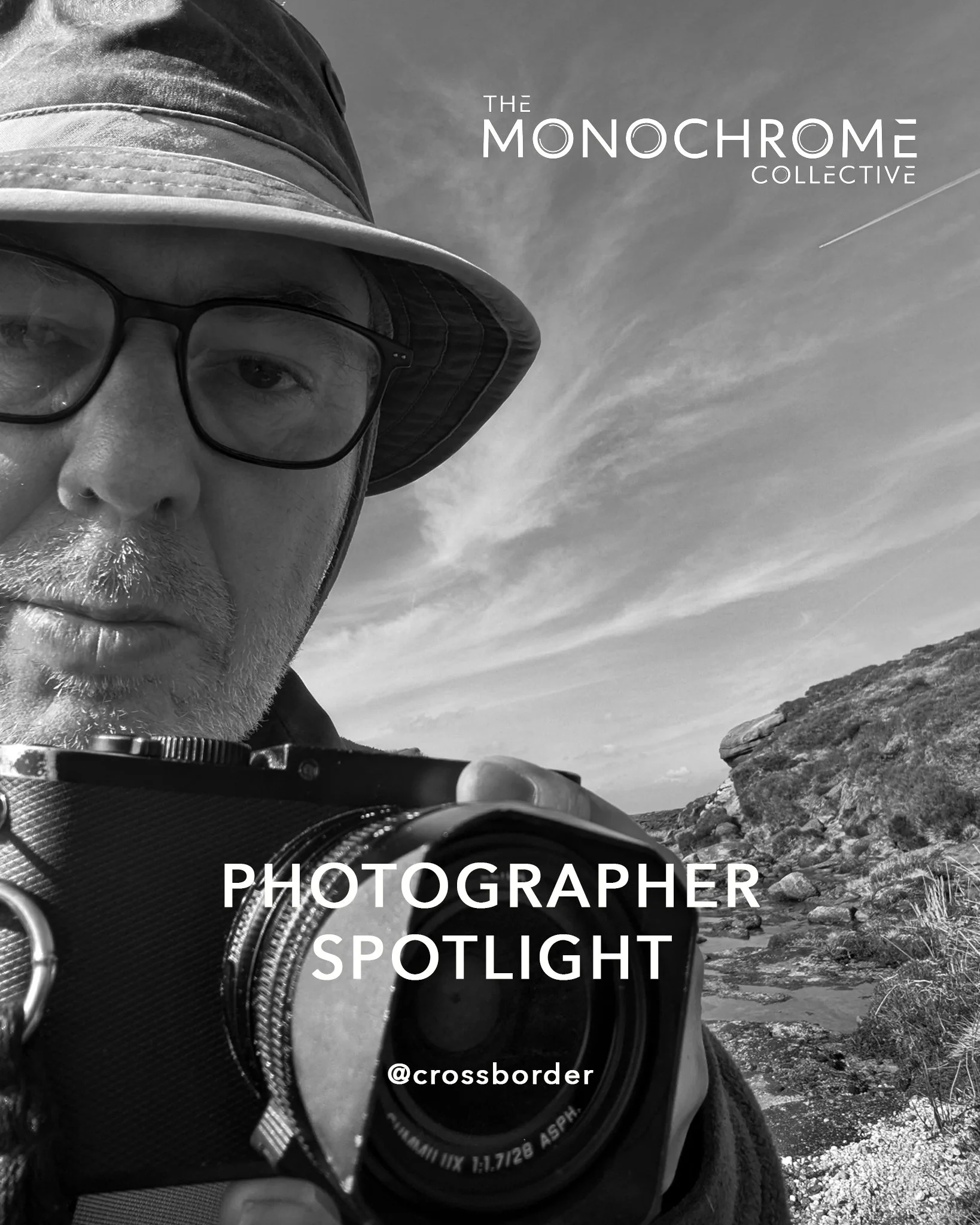
There's always a moment that pulls someone into photography for good. What was yours?
I honestly can’t think of a single moment. Sounds corny, but I’ve been into photography for as long as I remember. My Mum used to give me an old, Brownie camera to play with, one of those bakelite ones. Very occasionally she would even put a film in it! But I used to carry it round and ‘take’ photos all the time - if I close my eyes now I can still see through that grimy viewfinder. I’m talking about when I was four or five kind of age here. My parents walked a lot, in the hills, the Pennines of northern England, so I took landscapes. They put a film in when I went out! Not much has changed I guess.
What subjects are the focus of your work and why?
Landscapes, including urban landscapes, mainly, for my own project work. (I write for newspapers and magazines and sometimes do the photography for those too, but that is different.) Where I live, my closest city is Manchester. I tend to think in terms of river catchments, so I include everything from the headwaters on the moors to the centre of an international city as my subject, with the towns, villages and farms in between. And I live on a tiny island, remember, of Great Britain - it is only 30-odd miles from the middle of the moors to the centre of the city. That crowded aspect of human modified landscape fascinates me, so I am always trying to capture something of that.
Your black and white work has a particular feeling to it. How did you arrive at that? Was it deliberate or did it emerge over time?
I’ve always loved black and white, the chemical version - my first job was as a photographer on a local paper a long time ago, but the truth is, I was much better in the darkroom than in taking local news pictures. I used to love printing, and I’ve only recently stopped sulking with digital for putting an end to the chemistry of photography. I feel that black and white can capture moods better - I have never considered myself a good ‘single image’ photographer, but more a story teller, using sequences over time. So I suppose where I am now is both deliberate, and it has emerged over time, as I’ve experimented creatively with digital more. I hope I haven’t ‘arrived’ anywhere yet though! All is still evolving. It is all about how best to tell the story of the land I’m in, with an acknowledgement that it is me doing the telling.
Tell us the story behind one of your favorite photographs.
I find that really difficult, I don’t really have favourites. Or maybe in categories, so ones I like from the city, or moorland landscapes, or even in time - I might have a favourite from recently, which fades as its novelty might wear off. Maybe I’ll say that fence shot from recently, which I called: ‘The Meeting Place’, it fulfils a lot about black and white I strive for: a ‘something and nothing’ subject, but that can evoke a powerful story. That has to be my ideal: minimal subject, maximum impact.
What is one thing that you are working to improve in your photography and how are you going about it?
Someone once said to me about scriptwriting, that the important thing is to be able to create a world that people believe in, and you can then set your story in that. That is how I approach my own photography, I try to view the world as I see it and create a world people can believe in. I feel like I’m getting there with my landscape photography, and I now want to start to populate that world, by photographing environmental portraits of people. My aim is to be able to produce portraits that if they were seen alongside my landscapes, in series, they wouldn’t look out of place, each belonging to the other. I’m a long way off that yet, but that is my aim!
How much do you plan vs. shoot spontaneously?
I never plan, not times of day, not light, nothing. Improvising and thinking on your feet is the game, as far as I am concerned.
What gear do you bring when you go out to shoot?
As little as possible. 99% of the time, a Leica Q (28mm fixed focal length), occasionally use an old Leica X1 instead (35mm equivalent fixed). I hate too many choices! Plus I don’t like carrying things.
What does your editing process look like? What tools do you use and how do you approach it?
I use Darktable and that’s it. All I do is replicate what I used to do in the darkroom, except now I use physics instead of chemistry! So basic exposure, dodge and burn in (selective over and under exposure) and selectively vary contrast. I also add a bit of grain which I smile at the irony of doing so every time, but by trial and error I’ve got it so it doesn’t look like grain when / if I print the image (giclee on bamboo) it just takes the edge off the image slightly, which I like for my own project work. The Summilux on the Q can be a bit too clinical sometimes, for my own work.
Who are some photographers or artists that have influenced your style and why?
Fay Godwin - I think she is one of the best photographers / storytellers of the British landscape I know. She illustrated a book of poetry by the poet Ted Hughes, a tremendous writer, called the ‘Remains of Elmet’. It was about the Pennine landscape, with Godwin’s black and white photography. Hughes said that he wrote directly from some of her photographs, and he was so impressed he insisted she have joint credit on the book. That’s all you need to know about the quality of Fay Godwin’s work.
And a lot of American stuff, the New Topographics that so changed landscape photography in the 1970s - particularly Robert Adams and Lewis Baltz, Stephen Shore of course. And special mention for Nan Goldin - brilliant storyteller! Loads of others.
What would you tell yourself when you started in photography? The thing nobody said to you that would have changed how you photographed?
Don’t confuse commercial work, stuff you’re trying to sell, with your own work. The aims are completely different. Commercial, and you have to please others. But for your own work, your first obligation is to yourself. If others like your work too, it is a bonus, and a lovely bonus. But it mustn’t become the primary aim.
If you would like to see more of Andrewss work you can find him on foto @crossborder