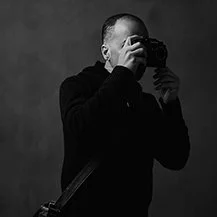
Photographer Spotlight: Edward Boches
You'll be bad before you're good. That was the whole lesson.
Edward Boches traces his pull toward photography back to a single image, John Filo's 1970 photograph of a woman kneeling over Jeffrey Miller, a Kent State student shot dead by National Guardsmen. The rawness of it, an entire story contained in one frame, has shaped everything he has made since. His documentary work moves through communities he starts out knowing nothing about, amateur boxers, oyster farmers, the homeless community of downtown Boston, inner city youth, circus performers, always built in collaboration with the people he photographs rather than at their expense.
He shoots almost entirely on prime lenses, a Leica Monochrom paired with a 28 or 35mm most often, and works instinctively, hunting for moments rather than waiting patiently for one to arrive. We asked him about the Yankee fan who told him not to take his picture, gave him the finger instead, and ended up paying him twenty dollars for the shot anyway.
Here is our interview:
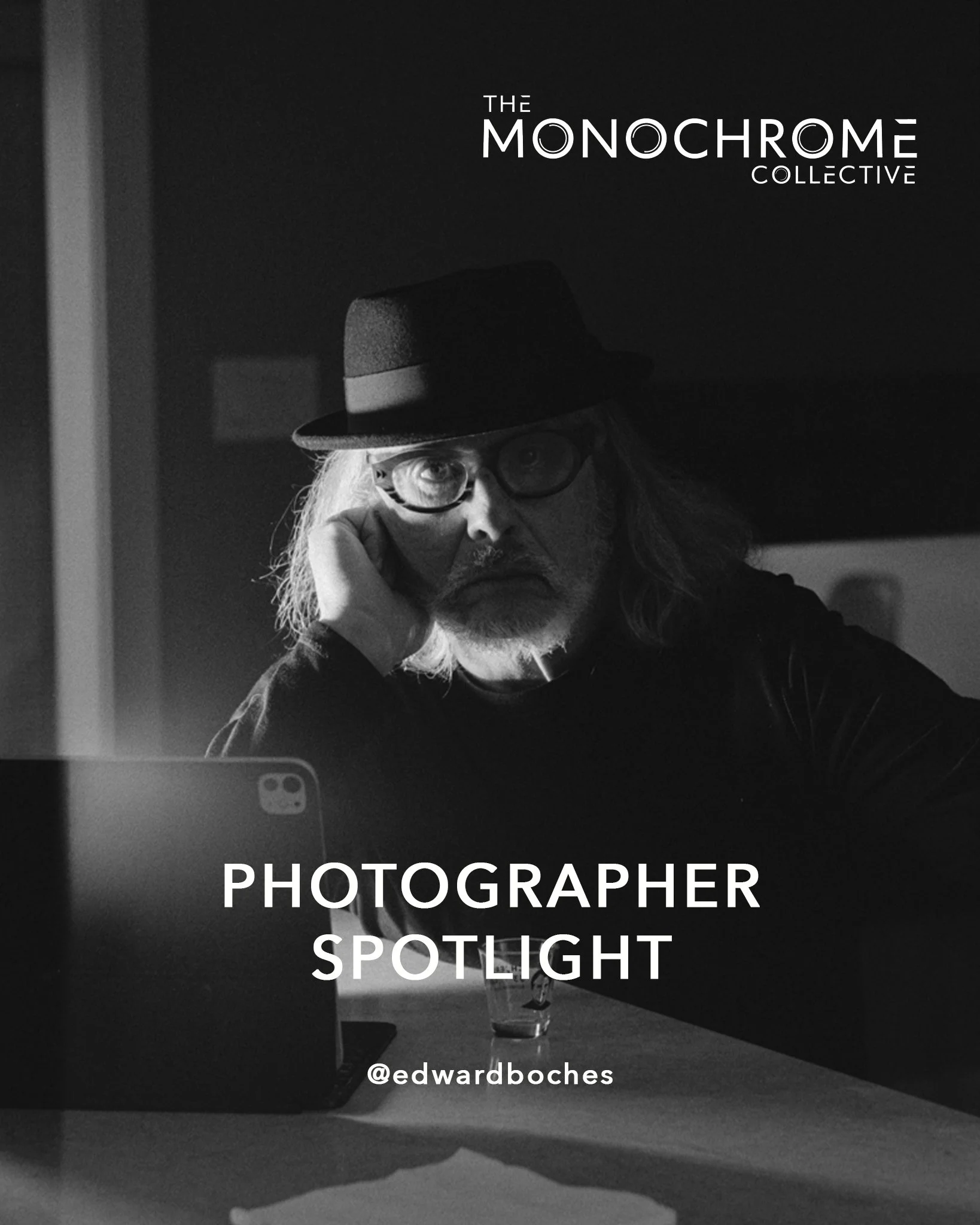
There's always a moment that pulls someone into photography for good. What was yours?
For me it was John Filo's 1970 photograph of a woman kneeling over the dead body of Jeffrey Miller, the Kent State student shot and killed by National Guardsmen. The raw power of the photograph, the emotion of the distressed woman, the entire story (or all that mattered) in a single photograph. Pure, raw, powerful.
What subjects are the focus of your work and why?
I tend to do documentary work about communities I know nothing about. It's a way of getting closer to humanity, people, their work and motivations, their challenges and determination, their fears and their passions. I've done deep documentary work on amateur boxers, oyster farmers, the homeless community of downtown Boston (in collaboration with my subjects, never in an exploitive manner), inner city youth, artists, circus performers and neighborhoods in transition.
Your black and white work has a particular feeling to it. How did you arrive at that? Was it deliberate or did it emerge over time?
Black and white eliminates anything extraneous. It allows you to see the subject in a purer way. By stripping away the color -- sometimes it is the subject but often it's distracting or competitive to the core story of the photograph -- you can bring the viewer closer to the moment, the place, the person. And it lets you use shape, geometry, light and shadow to frame and emphasize how you want an image to be seen.
Tell us the story behind one of your favorite photographs.
I live near Fenway Park in Boston and on occasion photograph fans outside the park. Once, before a NY Yankee game I was looking for Yankee fans to photograph. As one approached I lifted my camera and he declared, "Do not photograph me!" As he gave me the middle finger and pushed it toward my face I quickly took the photograph. He was stunned and insisted I show him the image. I did. He nodded and started to walk away as did I. But suddenly he turned and called, "Hey photographer." I turned, too. He came toward me, handed me a card and a $20.00 bill (which I tried to refuse, but he forced me to take) and said, "Email me that when you have a chance." And I did. Lesson: people ultimately like it when you're interested in them, so take the shot.
What is one thing that you are working to improve in your photography and how are you going about it?
I tend to see people, faces and subject first. So often I don't think carefully enough about frame, edges, layers and all the other visual elements that make for a captivating photograph. While that comes somewhat intuitively without thinking about it, I sometimes force myself to concentrate more on that rather than merely the person or community I am documenting. Some photographers find a place -- light, shadow, background -- and wait for something to happen. I don't have the patience. I hunt and move in constant search of an image or moment that attracts my attention. That makes it harder to think about all that makes a great frame. So sometimes it takes a bit of reminder and extra concentration.
How much do you plan vs. shoot spontaneously?
For me everything is spontaneous. I may plan where I am going and what subjects or place I want to photograph. But I don't set up shots, or have subjects pose, or use a tripod. I look, watch, feel and respond, trusting my instincts.
What gear do you bring when you go out to shoot?
I almost always shoot with a prime lens -- unless I am covering something like a boxing match, where I can't move around as much and may want wide, medium and close-up images of fast moving fighters -- so I often carry two cameras. Usually a Leica Monochrom with a 28 or 35mm lens. And perhaps a Leica Q2 or Q43 depending on where I am going and what I'm shooting. If indoors and darker I may use an SL2-S, which has a 24 MP sensor and is much better in low light. On occasion I shoot color, but always decide in advance. That way I either see color or black and white, far more often the latter. In which case the Monochrom is my go to. I like the sensor. For personal projects I still shoot film, mostly TRI-X. I was using Kodak Double X, which I could bulk roll from 400 feet to 100 feet to rolls of 36, but Kodak stopped selling it to anyone but film production companies as resellers were buying it, repackaging and rebranding and selling it online. I always rolled my own.
What does your editing process look like? What tools do you use and how do you approach it?
If I shoot film, I develop it myself and scan with a DSLR and 100 MM macro using a Negative Supply set up. The anodized aluminum rollers are precise and the light below the negative is consistent. I can scan a roll of 36 in less than two minutes. For digital I start in Lightroom and finish in Photoshop and or Camera Raw and Photoshop. On rare occasion, if there is a look I want to give a particular project I may use Nik Silver FX. I think that editing and post production can be as important as what a photographer captures on film or sensor, but at the same time I've come to realize less is more and restraint is essential. On social media one sees way too many over processed images. A viewer should notice the photograph not the processing.
Who are some photographers or artists that have influenced your style and why?
Garry Winogrand is one of my favorite street photographers. He was less about technique (the chiaroscuro that dominates Instagram) and more about the subject, the moment, and social commentary. Obviously Robert Frank and the Americans for the brilliant social commentary, story-telling and sequencing. His masterpiece is a master class in the latter. Diane Arbus for her portraits that were so honest and provocative. Graciela Iturbide for her incredible ability to capture the essence and spirituality of Mexico, and particularly for her images of Frida Kahlo's bathroom after it had stayed shut for 50 years, concealing her brace and crutches. And Salgado, especially his workers. He is one of the few photographers who can make you feel close to a subject even when he uses longer lenses.
What would you tell yourself when you started in photography? The thing nobody said to you that would have changed how you photographed?
1. You'll be bad before you're good. You're not supposed to be good when you start out. You probably got inspired to be a photographer because you were moved by something great. But you can't make great out of the gate. It takes time. 2. Put away the telephoto lens. Get a 35 MM or 28 MM and learn to get close, to move, to go to the frame. 3. Find your courage. Photograph people. If they get upset or appear suspicious, smile at them (smiles are tension breakers), compliment them (their glasses or hair or outfit), and start a conversation. Everyone wants to be noticed and loves when you are interested in them. So be interested.
If you would like to see more of Edwards work you can find him on foto @edwardboches or on his website www.bochesphotography.com.