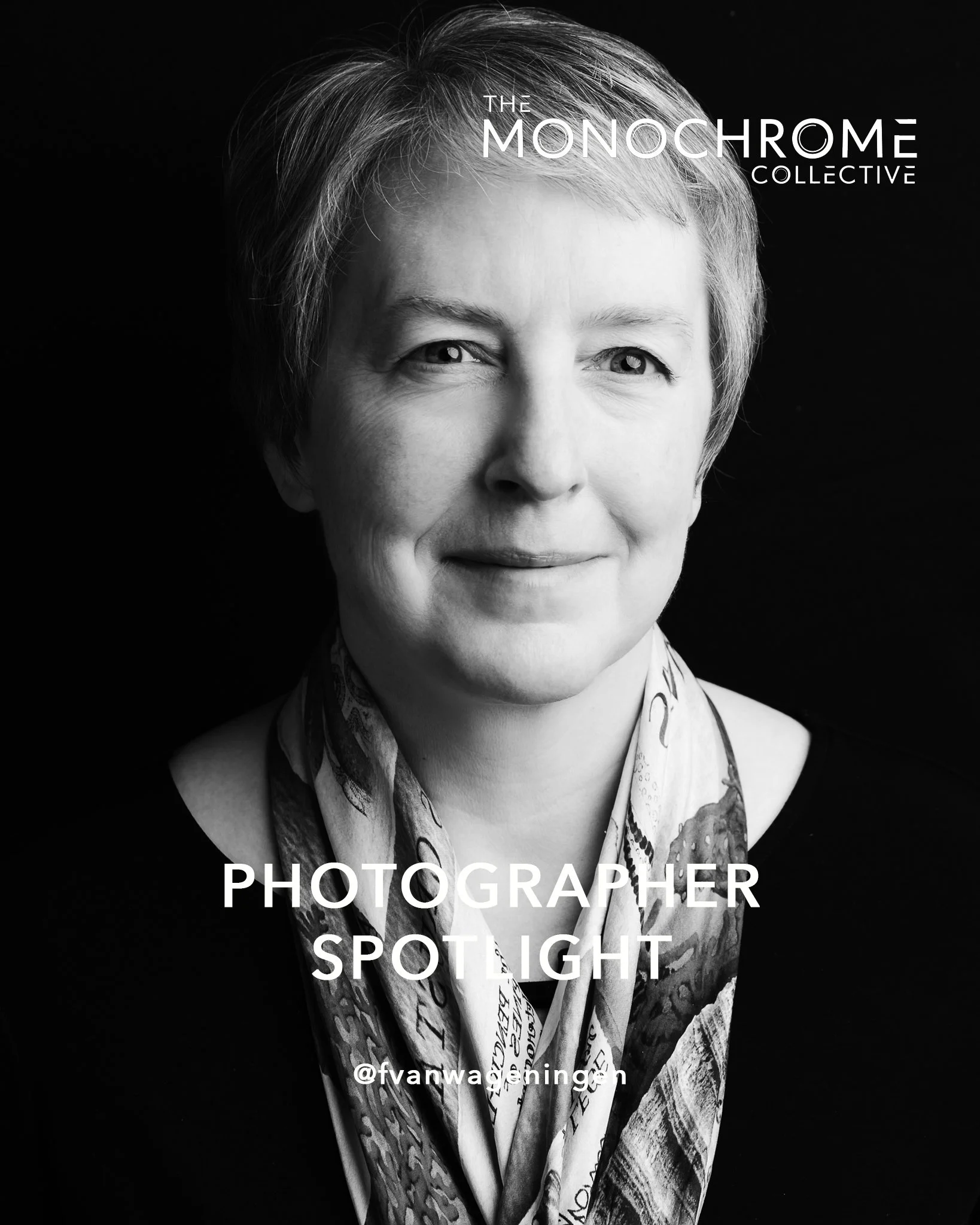
Photographer Spotlight: Flora van Wageningen
The image is a beautiful byproduct. The time spent together under the stars is what actually mattered.
Flora van Wageningen picked up photography as a deliberate act of restlessness. Settled in Calgary in her late thirties, bored with her work and with a city she had stopped really seeing, she gave herself five years to master the technical side of digital photography and to rediscover her surroundings through a camera rather than a phone screen. She found a supportive local photo community early on and never really stopped since.
Landscape and abstract work are where she keeps returning, drawn to quiet, solitary moments watching how light and shadow move, and lately she has been reexamining her own astrophotography specifically through black and white, questioning how much of the color in popular night sky images actually reflects what the eye sees standing under a genuinely dark sky. We asked her about a spontaneous evening spent photographing the Milky Way with her cousin on a lakeshore in British Columbia, and why she has been trying to slow down and resist the comparison trap that social media makes so easy.
Here is our interview:
here's always a moment that pulls someone into photography for good. What was yours?
When I was younger I moved around a lot. As I entered my late 30's I settled in Calgary. It didn't take long for me to get itchy feet. Work was no longer challenging and I was getting bored with the city. So I decided to challenge myself. I picked up a new digital camera and gave myself 5 years to master the technical aspects of digital photography and the suite of editing tools, and to get out and try and see my city and area in new ways. We spend so much of our time sitting and staring at our phones, I wanted to reconnect with the world and challenge my "boring" idea of the city and see what I could find. I luckily found a very creative, helpful and supportive photo community in the beginning where I connected with more creatives and things have gone on from there.
What subjects are the focus of your work and why?
I have tried my hand at many different genres but there were a few, like sport and portraiture that didn't suit me. I always seem to come back to landscape and abstract photography. I love those quiet moments alone in nature, just observing the movement of the light and shadows. Or experimenting with abstract photography in camera and in post where you can really explore your own creative processes.
Your black and white work has a particular feeling to it. How did you arrive at that? Was it deliberate or did it emerge over time?
My black and white work continues to evolve. I like how black and white gets to the narrative removes distractions. How it plays in only light and shadow. Currently I am re-examining my astrophotography in black and white. I have always not felt quite right about how much colour we see in these night images. Often pushing the boundaries in post production beyond reality. I am looking to explore these images as purely light in the darkness. Standing under the new moon in the dark searching out the Milky Way you realize how much light we are blinded to in our modern cities. When you catch a glimpse of it in the dark you rarely see the bold colours you see online. It is much more subtle and this is where black and white can work well to communicate.
Tell us the story behind one of your favorite photographs.
Last year I was visiting my cousin in Nakusp BC. Walking along the shoreline in town one night I noticed the milk way. Most photographers will tell you, you can't see or photography the Milky Way unless you are in a dark sky preserve miles for the nearest town. But here in this small mountain community I could see it clearly across the lake while standing under the streetlights. I mentioned this to my cousin and she was up to pose for me in the edge of the lake. Without strobes or light painting and only the reflected lights from the town behind us we spent a fun hour playing under the Milky Way. It is this time spent together under the stars that means the most. The image is a beautiful byproduct.
What is one thing that you are working to improve in your photography and how are you going about it?
Comparison. Social media platforms like IG and Facebook inundate you with images to compete with your attention. It is easy to get caught up in the comparison game and "oh, I need to shoot like that". I enjoy Foto apps lack of algorithms. I see images as they are uploaded or curated by what I choose to see and explore. But I limit the amount of time now. I spend more time looking at my own images, analyzing what I like, what I would change, how I would improve it. I am also slowing down. Taking my time at a location, sometimes sitting with it before I even start composing. Revisiting and watching the light. I am trying to be more thoughtful and purposeful in my compositions.
How much do you plan vs. shoot spontaneously?
I am very much a spontaneous creative. There are some places I have ideas on that may take years before all the factors line up but I revisit them and patiently work on them. The rest for me are those spontaneous moments. That flash of shifting light. Shimmer of rain or blurring quiet of snow.
What gear do you bring when you go out to shoot?
My gear changes over time. I live near the mountains so a flexible zoom lens is a staple as I can't always move my feet to where I need to be due to obstacles or access so the flexibility of a zoom lens is ideal. I have slowly moved to mirrorless and lighter lenses as I get older and a light weight compact tripod is always with me.
What does your editing process look like? What tools do you use and how do you approach it?
Most of my editing is done in Lightroom. I use it to organize my catalog and collections to group my images. My abstract work tends to be more in photoshop as I utilize layers and blend modes.
Who are some photographers or artists that have influenced your style and why?
Paul Zizka is still one of my favourite mountain and ice photographers. Local and one of the cofounders of my local photo community Paul has been one of my most inspiring teachers. His willingness to share, his enthusiasm for photography is infectious and he is genuinely a lovely person.
My second favourite photographer is Vincent Munier. His Arctic photography are some of my favourites. The quiet simplicity of his still and intimacy of his images always amazes me. His use of negative space and composition is sublime.
What would you tell yourself when you started in photography? The thing nobody said to you that would have changed how you photographed?
Keep it simple. You don't have to include everything in an image, find the one thing you want to communicate and focus in on that and how you can make that come across in one single click.
If you would like to see more of Floras work you can find her on foto @fvanwageningen or on her website floravanwageningen.myportfolio.com