Build the Practice. Everything Else Follows.
It is not about making great photographs every time you go out. It is about going out.
Here is the simplest and most honest definition of a photography practice we can offer. Regular intentional engagement with the act of making photographs. Not every frame has to be great. Not every outing has to produce anything worth keeping. The value is in the showing up consistently rather than the quality of any individual session.
That sounds simple. It is also one of the hardest things to actually do. And it is probably the single most important factor in how fast a photographer develops over time.
What regularity actually does
The eye develops through use. Not through reading about photography or watching tutorials or buying better gear. Through the repeated act of looking at the world through a viewfinder with intention. This is not a metaphor. The visual instincts that produce good photographs are built through consistent exposure to the act of seeing.
A photographer who goes out once a month is starting close to scratch each time. The eye has to warm up again. The instincts have to reactivate. The particular quality of attention that photography requires has to be rebuilt from near zero. There is nothing wrong with this. Some very good photographers work this way. But it is a slower path than it needs to be.
A photographer who goes out every week is building on what they found last week. The eye picks up where it left off. The instincts are still warm. The quality of attention arrives faster because it has not fully dissipated since the last time it was needed.
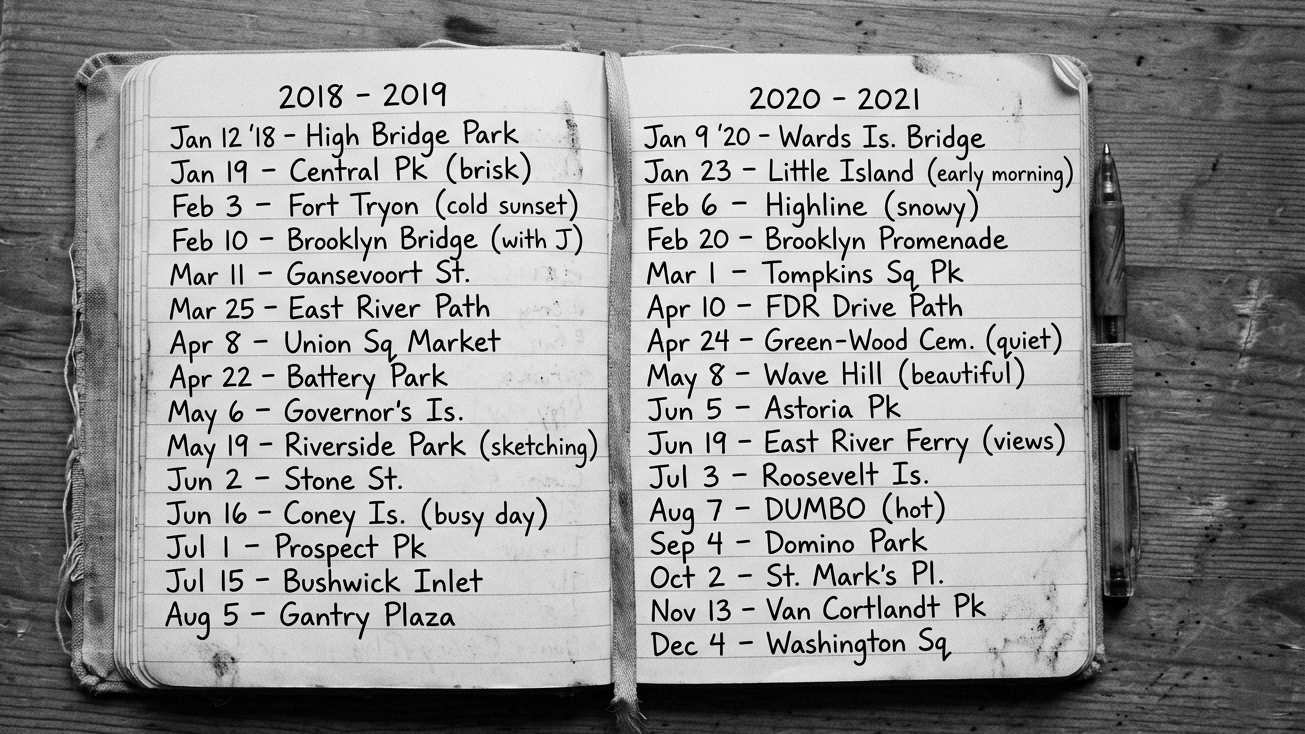
A photographer who goes out every day is developing something rarer and more valuable than either. A continuity of attention. The ability to notice change in familiar places. The way a location shifts across seasons and times of day. The way your own responses to subjects evolve week by week in ways you could only see if you have enough data points to track them. None of this is available to the occasional photographer regardless of how talented they are. It only comes from showing up regularly enough that the practice has a rhythm and the rhythm has a momentum.
The routine removes the decision
One of the least discussed benefits of a regular practice is that it removes the need to decide whether to go out.
Decision fatigue is real and it quietly destroys more photography than bad light or bad gear ever has. When going out with the camera is something you do when you feel like it, when the conditions seem right, when you have enough time and energy, when you are sufficiently inspired, you will go out far less often than you intend to. The conditions are never quite right enough. The energy is never quite sufficient. The inspiration comes and goes and mostly goes.
When going out is simply what you do on Saturday mornings it happens regardless of how you feel about it. The routine carries you through the days when motivation is low. It removes the negotiation between the part of you that wants to make photographs and the part of you that would rather stay on the couch. The decision has already been made. You just go.
And something interesting happens on those low motivation days. Some of the most honest and unexpected work gets made precisely because you are not trying to make something special. You went out because it is what you do on Saturday mornings and you made photographs because you had a camera and there was a world in front of you. That absence of pressure produces a quality of attention that high motivation sessions sometimes actually work against.
The bad days are part of it
Every photographer has sessions that produce nothing worth keeping. Days when the light is flat and the subjects are absent and nothing clicks and you come home with a card full of frames you will delete without a second look. These days feel like failures. They are not.
They are part of the practice in exactly the same way that a difficult practice session is part of a musician's development. The eye is still working even when the results are not showing up. The patience is still being built. The habit of looking is still being reinforced. The neural pathways that make a photographer respond instinctively to light and moment and geometry are still being laid down one session at a time regardless of what comes out the other end.
The bad days make the good days possible. Not metaphorically. Literally. The good day when everything clicks and the photographs arrive fully formed is built on the accumulated foundation of the days when nothing worked. You cannot have one without the other and the photographers who understand this show up on the bad days with the same consistency they bring to the good ones.
That consistency is the practice. The practice is what builds the photographer. Everything else, the gear, the technique, the knowledge, is in service of that.
What does yours look like
This is where we want to hand the conversation over to the Collective because this is something we are genuinely curious about and that we think you will find genuinely interesting to read in each other's answers.
Not the ideal version of your practice. The real one.
How often do you actually go out. Do you have a routine or do you shoot when the opportunity arrives. Do you have a specific time of day or day of the week that belongs to photography or does it happen around everything else. What gets in the way. How do you feel when you have not shot in a while. Do you have rituals around it, a particular route, a particular cafe before or after, a particular way of preparing.
And the harder question. Is your practice what you want it to be. If not what is one thing you could change this week that would make it more consistent.
Drop it in the comments. We want to know. Not because there is a right answer but because hearing how other photographers actually live their practice is one of the most useful and most honest conversations a community like this can have.