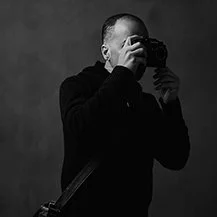
Photographer Spotlight: Kevin Delajoud
A French photographer who finds stories in empty spaces, graphic shadows, and the quiet tension between people and the city they inhabit.
Kevin Delajoud is a French photographer whose work sits at the intersection of street photography and graphic minimalism. He came to the medium through urban photography about fifteen years ago, drawn immediately to architecture, geometry, and the way cities organize space without people necessarily noticing. Three years ago, after the birth of his children, he found his way back to it with renewed focus and since then photography has taken an increasingly central place in his life.
His images are built around negative space, contrasting tones, and the carefully composed relationship between the human figure and the urban environment surrounding them. He is not interested in the decisive moment in any traditional sense. He is interested in what the city looks like when you slow down enough to actually see it. We asked him about geometry, emptiness, and why the right subject will always make the right photograph.
Here is our interview:
There's always a moment that pulls someone into photography for good. What was yours?
I think I’ve always loved taking photos. The first real spark came at the end of my studies about fifteen years ago, when I discovered urban photography — architecture and street photography. Then came a second turning point three years ago, after the birth of my children, when I finally found time again for photography. Since then, photography has continued to take on a bigger and bigger place in my life.
What subjects are the focus of your work and why?
The central theme of my work is the connection — or disconnection and reconnection, depending on one’s perspective — between people and their urban environment. City life is intense, yet people no longer take the time to observe, pause, or interact. That is why my approach relies heavily on photographic emptiness, which reflects a certain void in our lives. My work is also strongly rooted in geometry and graphic composition. I am constantly searching for shapes, lines, contrasts, and plays of shadow and light.
Your black and white work has a particular feeling to it. How did you arrive at that? Was it deliberate or did it emerge over time?
I work mainly in black and white, as this approach enhances the minimalist character, emphasizes contrasts, and strengthens the graphic dimension of my images. The process evolved naturally over time, through practice and the way my perspective has changed. I’m very drawn to negative space, and lately I’ve often been exploring how to highlight the human presence within those empty spaces.
Tell us the story behind one of your favorite photographs.
One photograph that has a particularly strong resonance for me was taken with my eldest son. When he was three years old, I wanted to take him with me on a photo walk to introduce him to my passion. On our way back, we passed by the entrance to an underground supermarket parking lot. The structure created a beautiful play of light, so I asked him to walk down the ramp and I took the shot. I think this image perfectly reflects my work: a place that seems completely ordinary and devoid of interest can still produce a powerful image. Since then, he has often accompanied me on my photo walks, even if he is not usually my subject.
What is one thing that you are working to improve in your photography and how are you going about it?
I am working on many things, but I would say one of the main areas is a series-based approach and editing. Being able to be more critical of my own work, to create coherence within a series, but also to establish rhythm by introducing variation while maintaining consistency and a clear thread.As a result, I now go out more and more with ideas in mind, looking for specific photographs.
How much do you plan vs. shoot spontaneously?
I would say 50/50. I still work in a very controlled approach to composition, which is the foundation of my work. I often identify a location and a light situation and compose the scene before bringing my subject into it. But increasingly, I also identify scenes and shoot more spontaneously, while still maintaining that graphic and minimalist approach.
What gear do you bring when you go out to shoot?
I use a Canon R7 mirrorless camera. In terms of lenses, I have a 16–28mm and a 28–70mm. I have to admit I’m neither a gear enthusiast nor particularly focused on technical aspects, so I don’t change equipment often once I feel comfortable with it.
What does your editing process look like? What tools do you use and how do you approach it?
I mainly use Photoshop. I usually do fairly minimal retouching on my images. The idea is simply to correct lines and geometry when needed (especially perspective), and to work on contrast and exposure in order to bring the image closer to the intention I had at the moment of shooting.
Who are some photographers or artists that have influenced your style and why?
There are many. The most important influence for me is probably Fan Ho. I recently discovered Ray Metzker and really appreciate his work as well. Naturally, the great names of street photography are also key references: Daido Moriyama for his constraints, Saul Leiter and Harry Gruyaert for their very subtle approaches to composition.
Finally, among more contemporary photographers, I really like the work of Alan Schaller, Nina Papiorek, Eric Forey, and Mark Fearnley.
What would you tell yourself when you started in photography? The thing nobody said to you that would have changed how you photographed?
First, learning how to deconstruct and “break down” urban elements in order to build compositions. Black and white street photography offers enormous possibilities if you approach the urban environment in its full depth and work with different layers and planes. You have to look “beyond” what you see and play with shapes and contrasts to create interesting frames.
And secondly, that the human element remains central, and that the right subject will always make the right photograph.
If you would like to see more of Kevins work you can find him on foto @kevindelajoud or on his website kevindelajoud.com