
A Novel Way To Measure Progress
The most reliable sign of growth in photography has nothing to do with your images.
Last night was Open Studios at the gallery. Once a month people come through, look at the work on the walls, and ask questions. It is one of my favorite evenings. Not because of the attention but because of what the conversations reveal, usually about the work, sometimes about me.
The questions are pretty consistent. Tell me about this photograph. What inspired you? How did you create this? Simple questions. But the answers are different now than they used to be and I have been thinking about why.
A few years ago I would have answered those questions with technical information. The camera I used. The focal length. The time of day and why the light was doing what it was doing. Exposure settings. How long I waited. The craft decisions I made in the field and in post. Accurate answers. Informative answers. And almost completely beside the point.
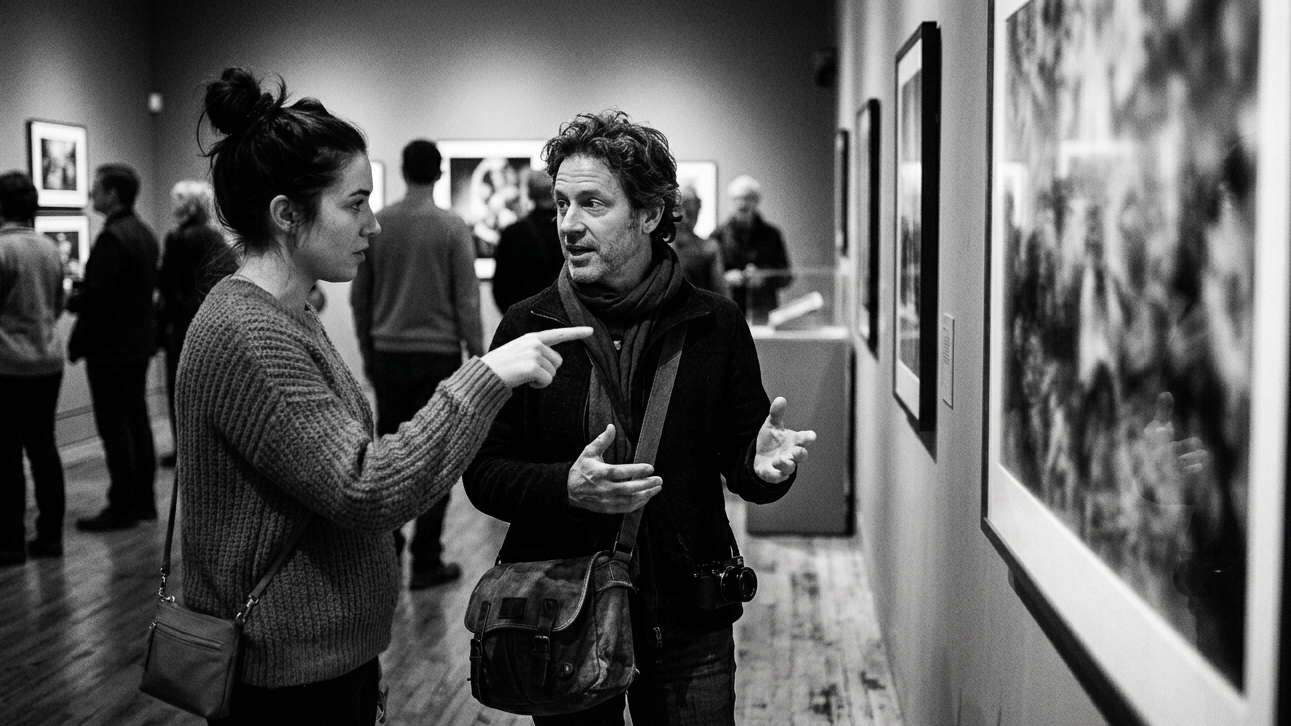
Last night someone pointed at an image and asked me to tell them about it. What came out of my mouth was a story. Where I was and why I was there. What I felt when I saw the scene forming. What I was trying to hold onto when I pressed the shutter. What the image means to me now, months after making it, and how that meaning has shifted slightly from what I thought I was making at the time.
Not a single f-stop mentioned.
That shift, from technical answers to story-driven answers, is one of the most reliable indicators of progress I have come across. And it is one that almost nobody talks about.
The predictable ways we measure progress
Most photographers measure progress in the obvious ways. They compare old work to new work and look for improvement. They enter competitions and use placements as a benchmark. They track followers and engagement as a proxy for whether their work is resonating. They ask for feedback from other photographers and measure growth by how the feedback changes over time.
These are all legitimate. Comparing your work from a year ago to your work today is genuinely useful. Honest feedback from people whose judgment you trust is valuable. None of these are wrong.
But they all measure the output. The image. What ended up on the card or the wall. They do not measure what is happening inside the photographer. And what is happening inside the photographer is where all the important progress actually lives.
The technical phase
Every photographer starts in the technical phase. You have to. The craft has to become instinctive before you can stop thinking about it and start thinking about what you are actually doing. Understanding exposure, learning to read light, developing an eye for composition, building the muscle memory that lets you operate the camera without looking at it, all of this is essential groundwork and there is no shortcut through it.
In this phase when someone asks about your work the honest answer is technical because that is where your attention actually lives. You are thinking about the craft. The image is mostly a record of the craft decisions you made. And that is fine. It is where everyone starts.
The shift
At some point, if you keep going, something changes. The technical decisions become automatic. You stop thinking about them because you do not need to. And into the space that opens up comes something else. Intention. Feeling. A reason for making this image rather than any other image. A sense of what you are trying to say and why it matters to you personally.
This is when the answers to questions about your work start to change. Not because you have decided to sound more like an artist. Because the truth of what you were doing when you made the image is now more about meaning than mechanics.
“the image is now more about meaning than mechanics”
When someone asks what inspired a photograph and your genuine answer is a feeling you were chasing, a memory the scene triggered, a quality of quiet you wanted to hold onto, you have moved somewhere real. The technical information is still there and still accurate. It has just stopped being the most interesting thing about the image.
Listening to yourself
Here is the practical takeaway. The next time someone asks you about a photograph, or the next time you find yourself writing a caption or describing an image to another photographer, pay attention to what comes out first.
If it is technical information that is useful data. Not a criticism. Just a signal about where your attention currently lives.
If it is a story, a feeling, an intention, a reason that has nothing to do with camera settings, that is also useful data. It means the craft has become transparent enough that you can see through it to what the image is actually about.
Most of us oscillate between the two depending on the image, the audience, and how confident we feel about the work. That is normal. But the general direction of travel, whether your default answer is moving from technical to meaningful over time, tells you something honest about where you are.
Open Studios last night reminded me of this. I did not go home thinking about the photographs. I went home thinking about the conversations. About what I said when someone pointed at an image and waited. About what came naturally and what I had to reach for.
That is a more honest measure of progress than anything hanging on the wall.
Ready to see the world differently? The Monochrome Method is a complete video course with lessons and assignments designed to help you craft compelling black and white images and build a portfolio that's unmistakably yours. Start Learning Today.
IF YOU WOULD LIKE TO IMPROVE YOUR BLACK AND WHITE PHOTOGRAPHY TRY THE LESSONS BELOW.




A Beginners Guide To Black And White Photography