You do not need a beginning, a middle, and an end. You need one moment that implies all three.
Here is something that trips a lot of photographers up. They hear that photographs should tell stories and they immediately think about sequences. A series of images that show what happened before, what is happening now, and what comes next. Beginning, middle, end. The whole arc laid out across multiple frames.
And then they look at a single photograph and think how is that supposed to be a story. Nothing has happened yet. Nothing has happened after. It is just one moment.
This is the misunderstanding. And once you see past it your relationship with single images changes completely.
The story is not in the photograph
Here is the thing. The story is not actually in the photograph. It is in the viewer. What the photograph does is give the viewer’s imagination enough material to construct the story themselves. And a story that a viewer constructs themselves is more powerful than one that is handed to them completely because it is personal. It belongs to them. They felt it rather than just saw it.
Think about the last time a photograph genuinely stopped you. Really stopped you. Made you look for longer than you normally look. The reason it stopped you was almost certainly not because it showed you something complete and resolved. It stopped you because it raised a question you wanted to answer. Because something in the frame implied a before and an after that you could not see. Because your imagination kept working on it after your eyes moved on.
That is the story. Not what is in the frame. What the frame makes you wonder about.
The empty chair
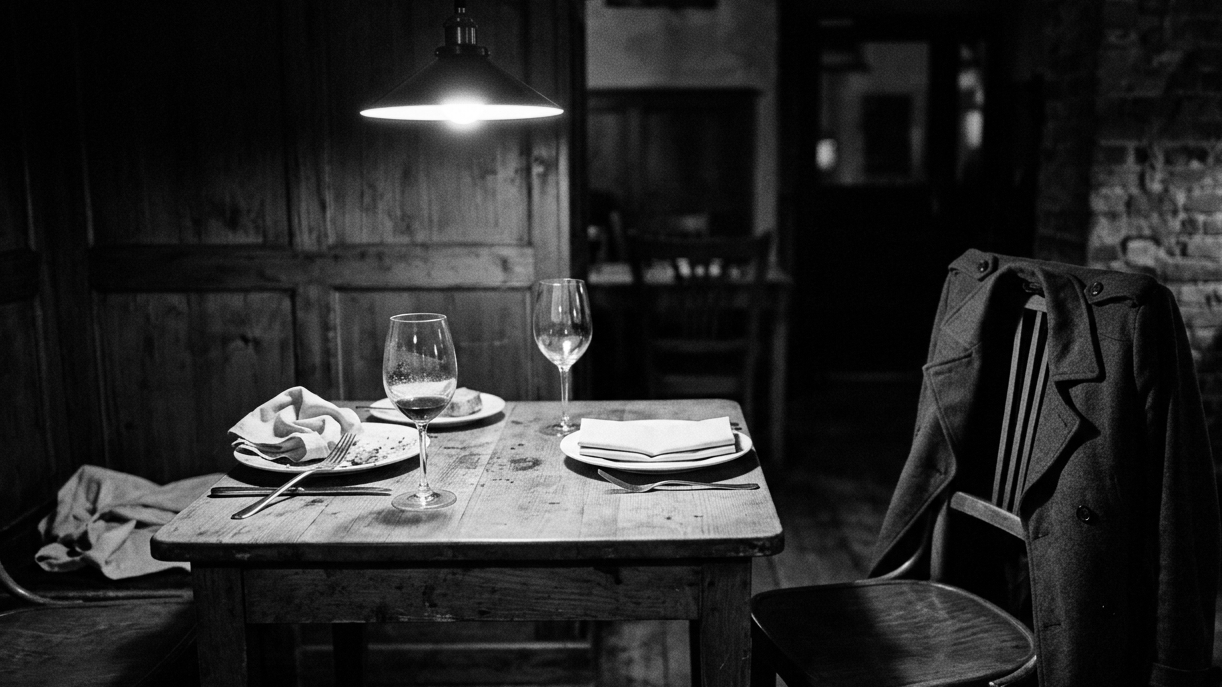
Take a simple image. A single chair at a table set for two. One place has been used. The other has not. There is a glass of wine half finished on one side and an untouched glass on the other.
Nothing is happening in this photograph. Nobody is in it. And yet you immediately have questions. Who was supposed to be here. What happened. Did they not come. Did they leave. Was this a first date or a last one. Is someone waiting or has someone given up waiting and gone.
The photograph does not answer any of these questions. It cannot. It is one moment. But it contains enough to make the viewer’s imagination run forward and backward from that moment simultaneously and the story that emerges from that running is completely real even though the photograph never showed it.
The beginning is implied by the set table. The middle is implied by the half finished wine and the untouched glass. The end is open and that openness is not a weakness. It is the most powerful thing about the image. An open ending keeps the viewer in the story longer than a resolved one ever would.
The figure walking away
Here is another one. A figure walking away from the camera down an empty street at night. You cannot see their face. You cannot see where the street goes. The light is falling in a way that makes the darkness ahead feel significant.
Again nothing is literally happening. One person walking. That is all. And yet you feel the weight of the image because everything about it implies movement through time. Something brought this person here. Something is pulling them forward. The street ahead is unknown and the darkness suggests it matters. Where are they going. What are they leaving behind. Why does the way they carry themselves feel like it means something.
You constructed all of that. The photograph gave you a figure, a street, and a quality of light. Your imagination did everything else. And the story your imagination made is more affecting than anything the photographer could have shown you directly because it is built from your own experience of walking away from things, or watching people walk away, or being somewhere at night when the world felt larger and more uncertain than it does in daylight.
What the viewer brings
This is the part that most photographers do not fully account for. The viewer is not a passive receiver of the image. They are an active participant in the story the image tells. They bring their entire life to it. Every experience they have ever had of absence or anticipation or longing or departure. Every time they have sat at a table and waited. Every night walk they have ever taken. Every goodbye.
When a photograph implies rather than shows it activates all of that. It gives the viewer’s experience somewhere to go. And the result is not one story. It is a different story for every person who looks at it. Each one true. Each one personal. Each one more resonant than anything a fully explained photograph could produce.
This is why the images that last tend to be the ones that hold something back. Not because mystery is a technique to be applied but because the imagination is more powerful than any camera and the best photographs understand that and make room for it.
What to look for when you shoot
The practical implication is simple. When you are looking at a scene ask not just whether it looks good but whether it implies something beyond what is visible. Is there a question in the frame. Is there evidence of something that happened before or will happen after. Is there tension between elements that makes you wonder about the relationship between them. Is there an absence that implies a presence.
If the answer is yes you probably have the material for a story. If the honest answer is that the scene simply looks beautiful but everything in it is resolved and present and accounted for you have a beautiful image. But you may not have a story.
The difference is not about complexity or drama. The most powerful implied stories in photography are often the quietest ones. An empty coat on a hook. A window with a light on in a dark building. Two shadows on a wall where the people casting them are out of frame. A table laid for a meal that has not yet been eaten or will not be.
Small things. Ordinary things. But things that make the viewer’s imagination lean forward and ask what is happening here and that question is the beginning of every story worth telling.
Ready to see the world differently? The Monochrome Method is a complete video course with lessons and assignments designed to help you craft compelling black and white images and build a portfolio that’s unmistakably yours. Start Learning Today.