
A Photo Story: What the North Asks of You
Flora van Wageningen visited the Faroe Islands in the spring of 2018. Seven years later, in retirement, she returned to the images and found something she had not seen the first time.
There is a particular kind of photograph that does not reveal itself immediately. You make it, file it away, move on. Years pass. Then one day you return to it and something has changed, not in the image, but in you. You are ready for it now in a way you were not before.
Flora van Wageningen understands this well. In 2025, after a long career as an analyst, she retired and began the kind of reflective stocktaking that significant life transitions invite. She returned to her image archive, looking for photographs that still resonated. What she found, buried in a folder from April 2018, was a week she had spent in the Faroe Islands.
The images were originally shot in color. When she converted them to black and white, something shifted.
"The shift in presentation allowed the narrative within the images to evolve in ways I had not initially anticipated," she says. "Revisiting the images in black and white revealed new layers of meaning."
It is a quiet observation, but it contains something important. The Faroe Islands, as it turned out, had been waiting for black and white all along.
Going North
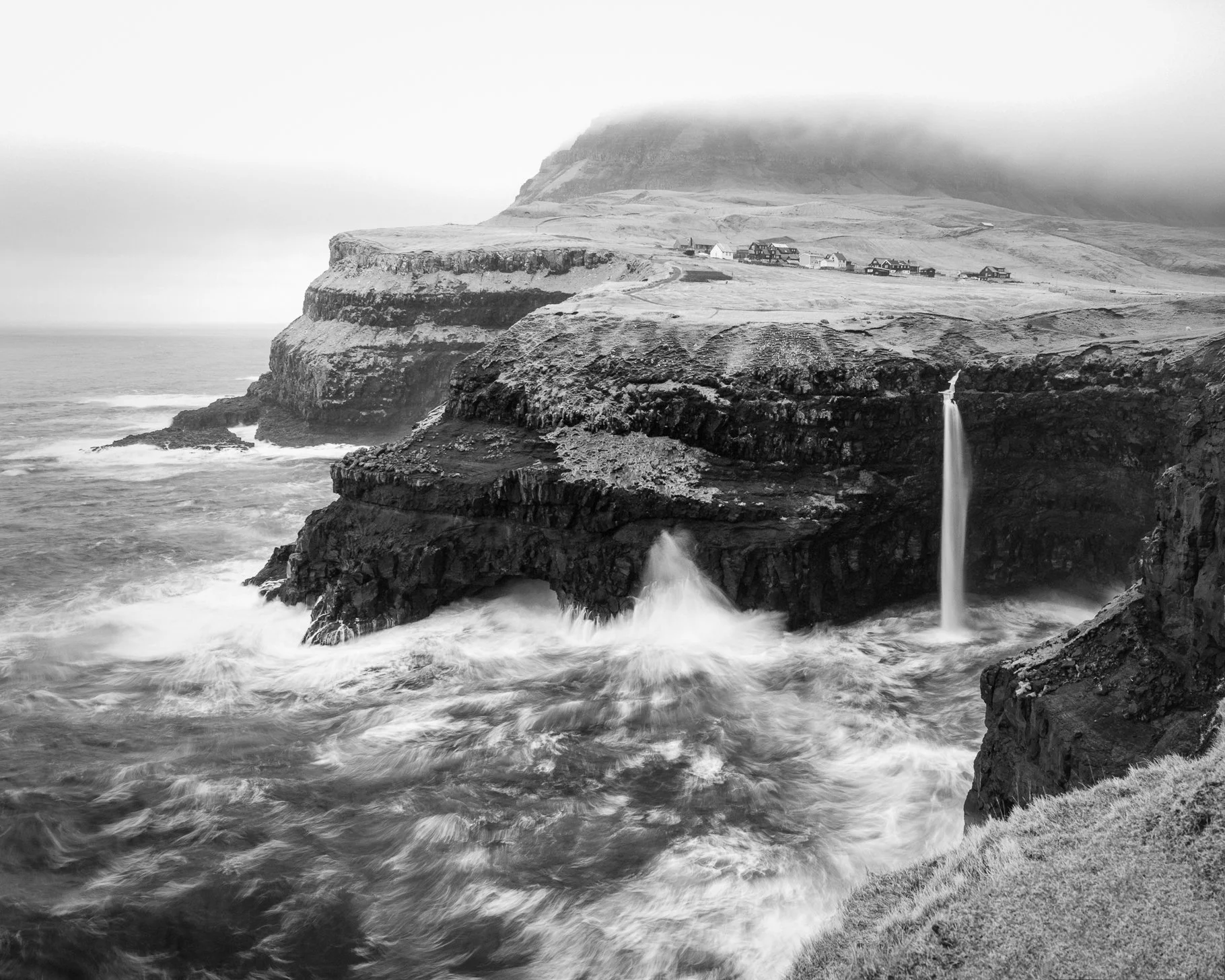
Flora has long been drawn to northern communities, places where the relationship between people and their environment is unmediated by the conveniences most of us take for granted. The Faroe Islands, an archipelago of eighteen islands sitting in the North Atlantic between Norway and Iceland, is exactly that kind of place.
She arrived in April 2018 with a Nikon D750 and a set of Nikkor lenses, a 24-70mm f/2.8 for the broad landscape work, a 70-300mm for reaching across distances, and a 20mm f/1.8 for the wide, immersive frames that the terrain demanded. Over the course of the week she traveled among the larger islands, the ones accessible by car and by the tunnels that connect them beneath the sea. The smaller outer islands, reachable only by boat, remained out of reach.
What she found was a landscape of extraordinary starkness. Heavy cloud cover sat low over the islands for most of the week. The grasses were muted. The rocky terrain absorbed light rather than reflecting it. The weather moved constantly, wind, rain, brief clearings, and then wind again.
"The heavy cloud cover and muted tones of the landscape naturally lent themselves to black and white imagery," Flora says. "The minimalism of black and white mirrors the stark and elemental nature of the environment itself."
Observation From a Distance
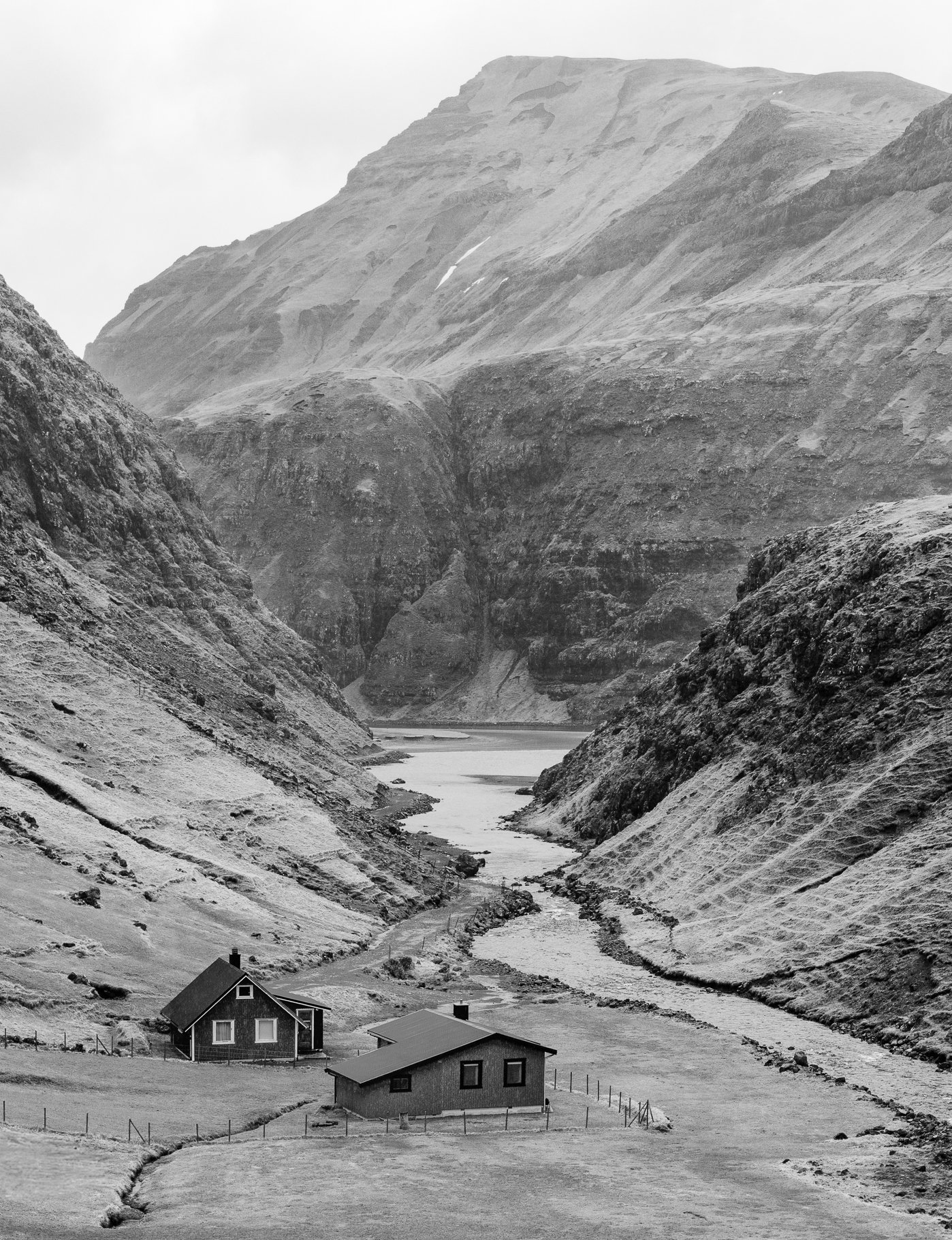
Flora is not a street photographer. She does not seek out confrontation with her subjects or engineer moments of intimacy with strangers. Her instinct is to observe, to position herself at a respectful distance and let the environment speak for itself.
Most of the people who appear in her Faroe Islands images were either traveling companions or local residents observed from afar. A figure on a morning ride. People walking down a hillside. Presences in a landscape rather than subjects to be interrogated.
"I try to avoid intruding on people's privacy," she says. "The environment itself often tells the story of isolation and quiet life in these places."
This restraint is visible in the work. The human figures in Flora's images are rarely close enough to read their expressions. They are scale. They are evidence of habitation. They remind the viewer that someone chose to live here, in this wind, on this rock, at this latitude, and found it sufficient.
The Road and the Figure
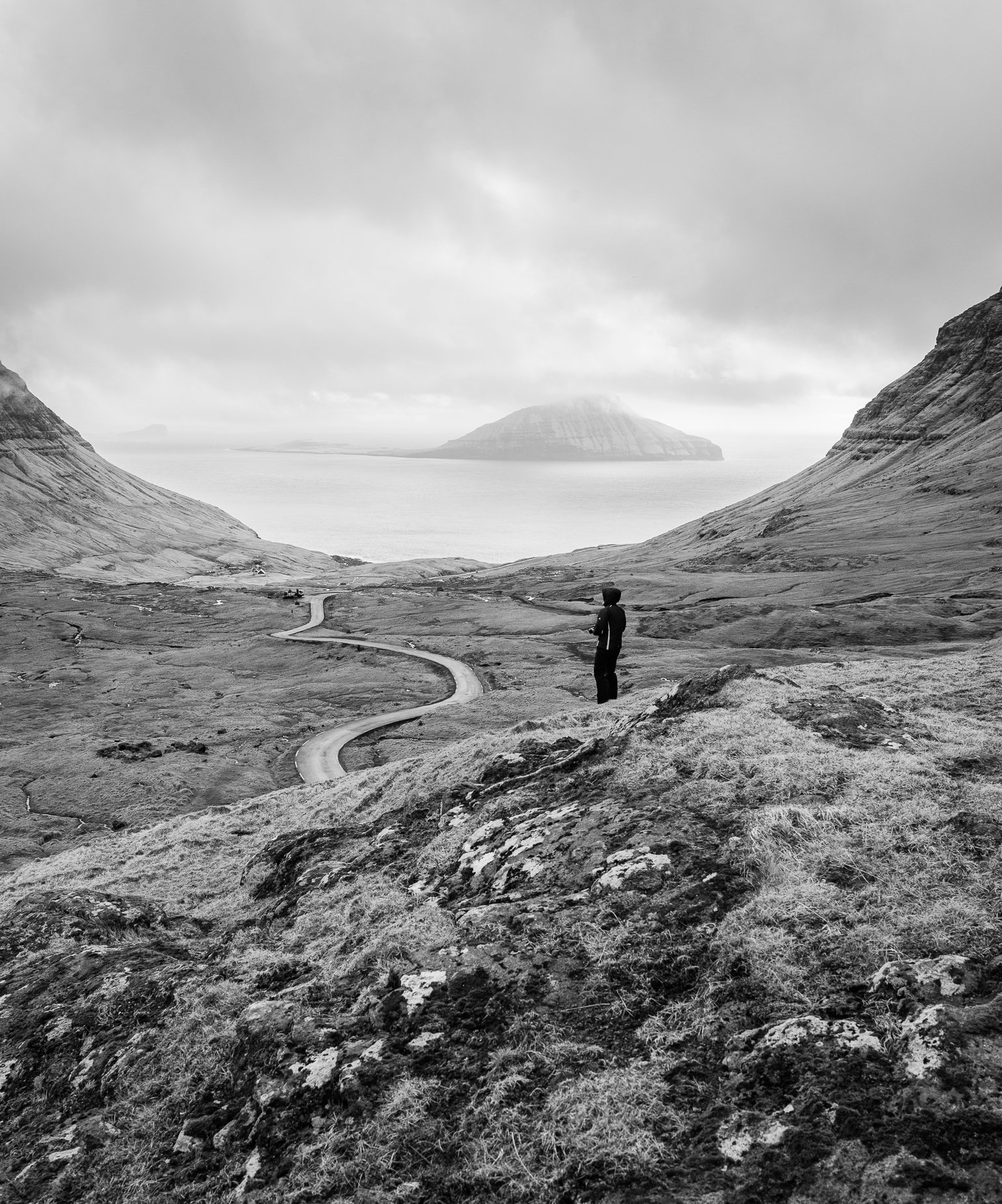
One image required more patience than the rest. A solitary figure stands in the distance along a winding road, the island visible in the background where the clouds have briefly lifted. It is a deceptively simple image, person, road, island, sky, but it took most of the week to make.
"Weather conditions on the islands can change quickly, with strong winds and rain making it difficult to work," Flora explains. "We returned to that location several times during the week before the clouds lifted enough to reveal the island in the background."
Even when the light finally came, the wind made tripod work difficult. The camera moved. The composition shifted. She held on and waited.
The resulting image has the quality of something earned. The figure on the road is small against the landscape, which is exactly as it should be. In the Faroe Islands, the land does not accommodate the human presence so much as permit it.
What the Islands Ask of You
Flora is careful about the word love when she talks about the Faroe Islands. It is not the right word for what she feels.
"My interest is rooted more in curiosity and respect," she says. "I admire the people who choose to live in such a demanding environment and manage to thrive there. It requires a strength and resilience that is easy to overlook from the outside."
This distinction matters. Love implies warmth and ease. What the Faroe Islands demand is something harder and more considered, the willingness to look at a life built on different terms from your own and ask what it means. What has been gained. What has been given up. Whether the trade was worth making.
These are not comfortable questions. They are the questions Flora found herself asking during the week she spent there, and the questions she returned to seven years later when she revisited the images in retirement, standing at her own threshold between one life and whatever comes next.
"In a world increasingly shaped by social media, constant news cycles, consumerism, and rising levels of anxiety, I found myself drawn to places that appear less influenced by the pace of the modern world," she says. "This series reflects on that contrast and invites viewers to consider what may have been lost in more developed societies and whether there is still time to reconsider what truly matters."
Black and White as an Act of Simplification
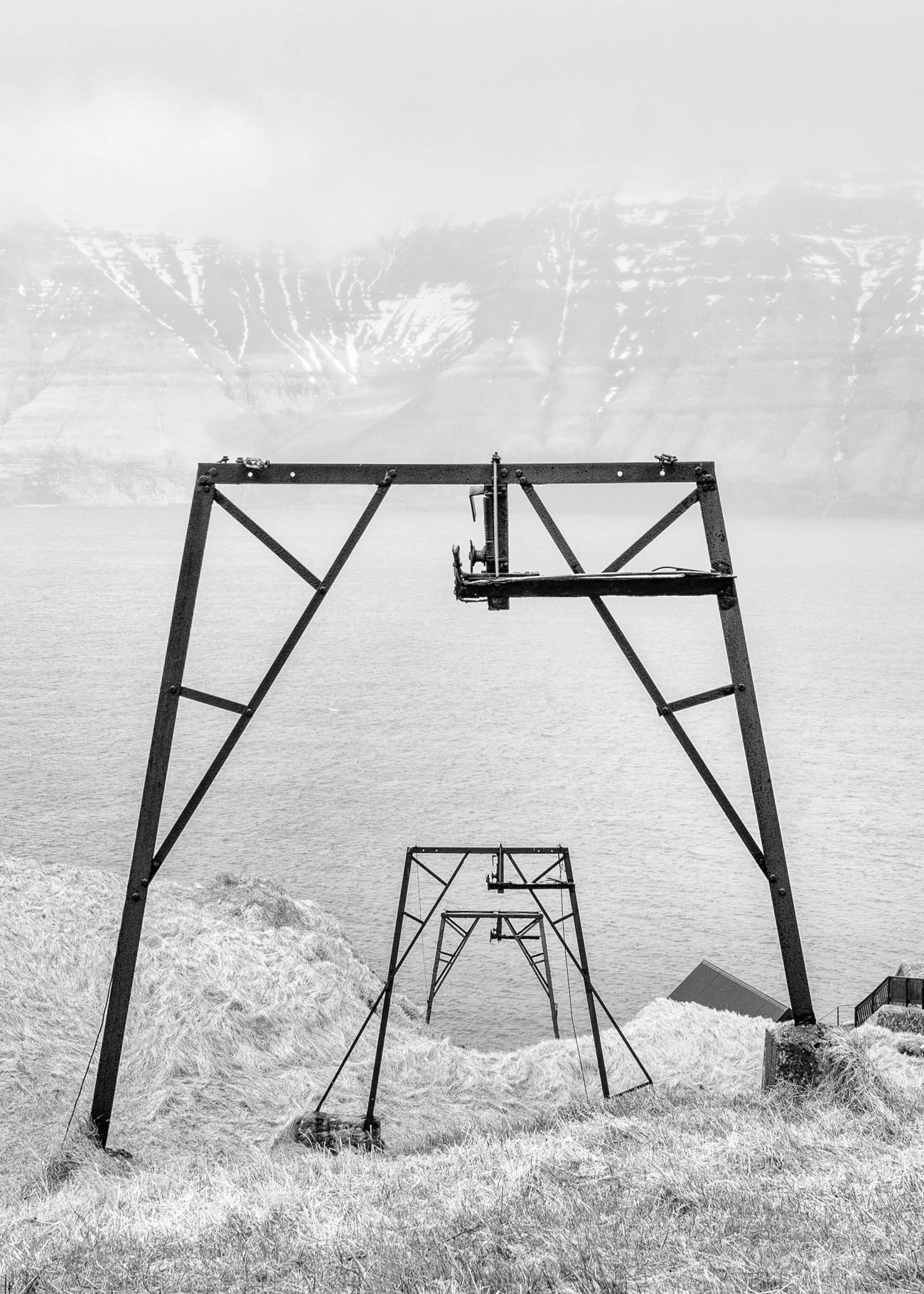
The decision to present the series in black and white was not made in the Faroe Islands. It was made seven years later, in retirement, when Flora returned to the images and understood what they needed.
Colour, in this context, would have been a distraction. The greens of the grass, the grey blues of the sea, the particular shade of the overcast sky, all of it would have pulled the eye toward surfaces rather than toward meaning. Black and white stripped all of that away and left what the photographs were always about: the relationship between the human presence and the elemental landscape that surrounds it.
Stark and simple. Like the islands themselves.
You can check out more of Floras work on foto @fvanwageningen or on her website floravanwageningen.myportfolio.com
Flora van Wageningen is a Canadian photographer based in Calgary. These photographs were made in April 2018 during a week spent in the Faroe Islands. All images were shot on a Nikon D750 with Nikkor lenses: 24-70mm f/2.8, 70-300mm f/4.5-5.6, and 20mm f/1.8. The series was originally photographed in color and converted to black and white in 2025.
Ready to see the world differently? The Monochrome Method is a complete video course with lessons and assignments designed to help you craft compelling black and white images and build a portfolio that's unmistakably yours. Start Learning Today.
IF YOU WOULD LIKE TO IMPROVE YOUR BLACK AND WHITE PHOTOGRAPHY TRY THE LESSONS BELOW.




A Beginners Guide To Black And White Photography