
Why Photography is Good for Your Mental Health
Photographers have always known that picking up a camera changes something. Science is catching up. Here is what the research actually says about photography and mental health.
There is a moment that most photographers recognize. You step outside with a camera and something shifts. The noise in your head gets quieter. You start paying attention differently. The same street you have walked a hundred times begins to reveal things you have never noticed before. You are not just looking anymore. You are seeing.
For a long time this was just something photographers said to each other. A feeling. An intuition. Something that happened but was difficult to explain. Now there is a growing body of research that explains why it happens and what it is doing to your mental health while it does.
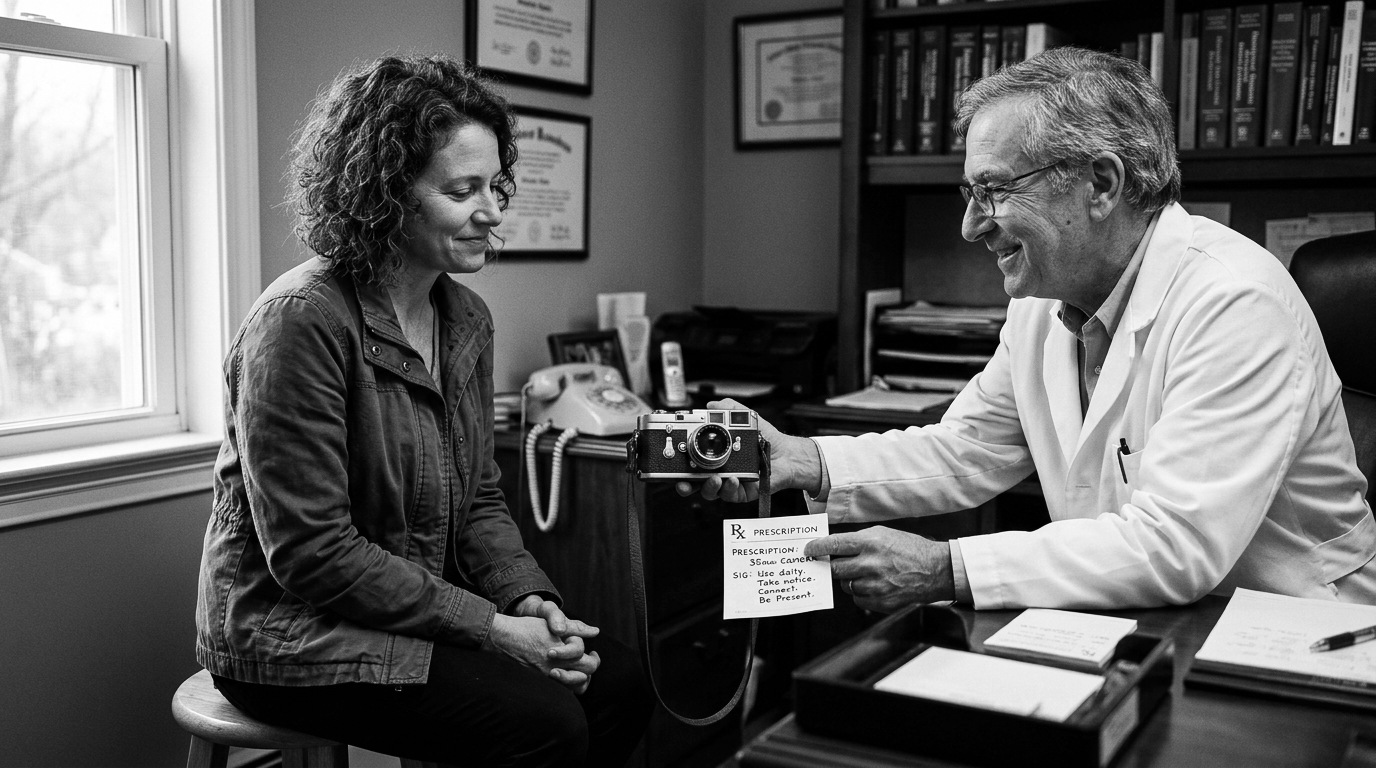
It Forces You Into the Present
The most immediate effect of picking up a camera is also the hardest to manufacture by any other means: it anchors you in the present moment.
When you are actively looking for a photograph, your brain cannot simultaneously be running through tomorrow's meeting or replaying last week's argument. The act of observation is incompatible with rumination. You cannot properly see what is in front of you and be somewhere else in your head at the same time.
This is not a philosophical observation. It is how attention works. Research consistently shows that ruminative thinking, the cycle of replaying negative thoughts, is one of the primary drivers of anxiety and depression. Anything that reliably interrupts that cycle has real psychological value. Photography interrupts it structurally, not by willpower or discipline, but simply by demanding that your full attention goes somewhere specific.
Researchers describe this as photography inviting a meditative focus, diverting the mind from ruminative thoughts and fostering a refreshing mental state conducive to creative expression. The camera is, in this sense, a tool for enforced mindfulness. One that most people find considerably easier to sustain than sitting quietly with their eyes closed.
It Trains You to Find Meaning in Ordinary Things
Depression does something specific to perception. It flattens the world. Things that used to feel interesting stop feeling interesting. Colour drains from ordinary experience. The capacity to find meaning in small things, a quality psychologists sometimes call savoring, diminishes.
Photography works directly against this. It is, at its core, a practice of finding value in what you observe. Every time you raise a camera to your eye, you are making a decision that this moment, this light, this detail is worth preserving. You are asserting that the ordinary world contains things worth paying attention to. Over time, that habit of attention changes how you see when the camera is not in your hand.
Research shows that photography helps bring focus to positive life experiences and enhances self worth, not through affirmations or forced positivity, but through the repeated practice of looking for what is worth seeing. It rewires attention, gradually, toward the particular and the present rather than the abstract and the anxious.
It Develops Real Skills and Skill Builds Confidence
There is something that happens when you get better at something. It is not complicated, but it is profound. Competence produces confidence. And confidence, the genuine kind earned through practice rather than received as reassurance, is one of the most reliable foundations for good mental health.
Photography is a skill with real depth. There is always more to learn, always a better understanding of light to develop, always a stronger compositional instinct to build. That depth matters. Research has found that photography improves self esteem and confidence in participants across a range of contexts, not just in clinical settings, but in community programmes, educational environments, and individual practice.
The process of learning, of genuinely improving at something through effort, produces a sense of agency. A sense that what you do makes a difference to what you get. In a world where many sources of anxiety are genuinely outside our control, that feeling of agency is not a small thing.
It Keeps the Brain Sharp
The cognitive demands of photography are considerable, and research suggests that demanding cognitive activity is one of the most reliable ways to maintain brain health over time.
Research by Professor Denise C. Park from the University of Texas found that participants who engaged in digital photography were able to enhance and improve their episodic memory and reasoning skills. Photography is not passive. It requires reading light, making compositional decisions, anticipating movement, understanding your equipment, and making rapid judgements about what matters in a scene. It is a full cognitive workout dressed up as something enjoyable.
This matters particularly as we age. Keeping the brain engaged in genuinely challenging activity is one of the clearest things the evidence supports for long term cognitive health. Photography provides that engagement without feeling like an obligation.
It Gets You Moving
This one is simple, but it is worth saying plainly. Most photography involves leaving the house. Walking. Covering ground. Being outside.
The evidence on exercise and mental health is about as solid as evidence gets. Physical activity releases endorphins, reduces cortisol, the primary stress hormone, and has been shown to be as effective as medication for mild to moderate depression in some studies. Walking, specifically, has a well documented calming effect on the nervous system.
Photography requires some form of physical activity and crucially, the brain is focusing on making images rather than working out, so the exercise is secondary. But it still delivers all the benefits you would get from a regular walk. You cover miles without noticing. You breathe fresh air. You move your body through space with a sense of direction and purpose. And you come home with something to show for it.
It Connects You to Other People
Isolation is one of the most significant risk factors for poor mental health. It is also, for many people, one of the hardest things to address directly. Reaching out is difficult. Showing up to something new is difficult. The vulnerability required for genuine human connection can feel impossibly large.
Photography offers a side door. It gives people a reason to gather, a shared language, and a subject of conversation that is not themselves. Research from Lancaster University underscores the positive influence of photography on wellbeing particularly for those coping with solitude, acting as a conduit for self expression and enabling individuals to forge and uphold a positive self concept even amidst isolation.
Photography communities, whether online or in person, tend to be unusually generous. People share knowledge freely. They offer feedback without agenda. They turn up for each other's work. The shared obsession with light and image creates a genuine bond between people who might otherwise have nothing in common.
It Gives You a Reason to Look Forward
One of the quieter effects of depression is the erosion of anticipation. Things stop feeling worth looking forward to. The future flattens. Tomorrow feels like today, which feels like yesterday.
A photography practice punctuates time differently. There is the location you have been meaning to visit. The light that only happens in a particular season. The project you are working toward. These are small things. But small things matter. The anticipation for the next opportunity to capture a moment can be the catalyst for a person to revitalise their self care practices. It gives the day a shape. It gives the week a direction.
Ready to see the world differently? The Monochrome Method is a complete video course with lessons and assignments designed to help you craft compelling black and white images and build a portfolio that's unmistakably yours. Start Learning Today.
IF YOU WOULD LIKE TO IMPROVE YOUR BLACK AND WHITE PHOTOGRAPHY TRY THE LESSONS BELOW.






A Beginners Guide To Black And White Photography